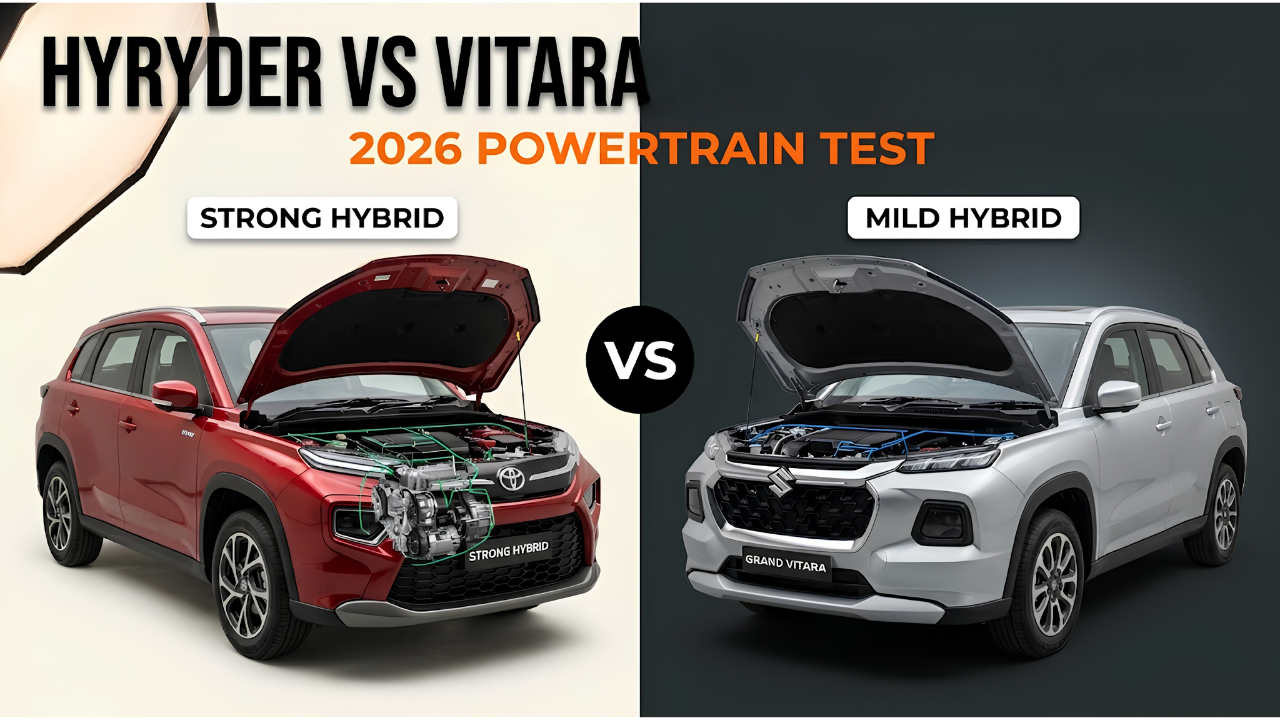

Is the Toyota Hyryder strong hybrid actually different from its Suzuki twin?
The short answer is: No, the powertrain is identical. Both the Toyota Urban Cruiser Hyryder and the Maruti Suzuki Grand Vitara use the Toyota-sourced 1.5L TNGA Atkinson Cycle engine paired with a self-charging electric motor. However, in 2026, the real difference lies in how much you pay to get into that hybrid seat.
While both cars deliver a claimed 27.97 kmpl, Toyota offers the strong hybrid in its entry-level “S” trim, making it roughly ₹1.5 Lakh cheaper than Maruti’s most affordable strong hybrid variant.
Hybrid Comparison Matrix (2026)
| Feature | Toyota Hyryder Strong Hybrid | Maruti Grand Vitara Strong Hybrid |
|---|---|---|
| Engine Type | 1.5L TNGA Atkinson Cycle | 1.5L TNGA Atkinson Cycle |
| Combined Power | 114.4 bhp (116 PS) | 114.4 bhp (116 PS) |
| Real-World Mileage | 22–25 kmpl (City) | 22–25 kmpl (City) |
| Entry Variant Price | ~₹16.90 Lakh (S Hybrid) | ~₹18.40 Lakh (Zeta+ Hybrid) |
| E20 Fuel Compliance | Yes (2026 Standard) | Yes (2026 Standard) |
| Battery Warranty | 8 Years / 1,60,000 km | 8 Years / 1,60,000 km |
The TNGA Architecture: How the Strong Hybrid Works
Both the Toyota Hyryder strong hybrid and the Suzuki equivalent run on the M15A-FXE engine architecture. Unlike a “mild hybrid” that only uses a small battery to assist the engine, these “strong hybrids” can drive on pure electric power for short distances.
The system uses an e-CVT (Electronic Continuously Variable Transmission). It’s a clever bit of engineering. Instead of physical gears or belts in the traditional sense, two electric motors (MG1 and MG2) work in tandem with the petrol engine to find the most efficient power split.
Why the Atkinson Cycle Matters
The 1.5L engine in the Urban Cruiser strong hybrid uses the Atkinson cycle, which delays the closing of the intake valve. It works. This creates a longer expansion stroke than compression stroke, extracting more energy from every drop of fuel. The tradeoff is lower low-end torque, which is why the electric motor (providing 141 Nm) is critical for that “instant” pull from a standstill.
Hyryder vs. Grand Vitara: The 2026 Variant Value Gap
If you are shopping for a Suzuki strong hybrid, you are forced into the higher-spec Zeta+ or Alpha+ trims. Toyota, however, democratized the tech by offering the Hyryder S Hybrid.
- The Entry Point: The Hyryder S Strong Hybrid starts around ₹16.90 Lakh. Maruti’s cheapest strong hybrid is the Zeta+, which starts closer to ₹18.40 Lakh.
- The “Missing” Middle: Maruti skips the mid-spec hybrid. If you want a hybrid with a balance of features but don’t need a 360-degree camera, the Hyryder G Hybrid is the sweet spot that Suzuki simply doesn’t offer.
- The Premium Top-End: At the top end (V vs Alpha+), the prices converge. Here, the choice depends on your preference for Maruti’s massive Nexa service network versus Toyota’s “Hybrid Expert” brand image.
Real-World Efficiency: Does it actually save money?
The reality? The Toyota Hyryder strong hybrid is marketed at 27.97 kmpl, but real life is messier. In 2026 traffic conditions in major Indian cities like Mumbai or Bangalore, you should expect:
- City Traffic: 23–26 kmpl (This is where the hybrid shines, as the engine stays off 60% of the time).
- Highway (80-100 kmph): 20–22 kmpl (The engine runs more frequently at high speeds).
- Highway (120 kmph+): 17–19 kmpl (Efficiency drops as the petrol engine takes over).
The Break-Even Math
If you drive 1,000 km per month:
- Petrol SUV (12 kmpl): Costs ~₹8,500/month (at ₹102/liter).
- Strong Hybrid (22 kmpl): Costs ~₹4,600/month.
- Savings: ~₹3,900 per month.
- Break-Even: If the hybrid costs ₹2.5 Lakh more than a comparable petrol-only SUV, it takes roughly 5.3 years of driving to recover the extra cost through fuel savings alone. Truthfully, if you don’t keep your cars for five years, the math might not work for you.
E20 Compliance and 2026 Regulations
As of 2026, all new Toyota Urban Cruiser Hyryder and Suzuki strong hybrid models are E20 compliant. This means the fuel lines, seals, and engine mapping are designed to handle 20% ethanol-blended petrol without corroding.
The catch? If you are buying a used 2022 or early 2023 model, check the fuel lid. Early batches were only E10 compliant. Using E20 fuel in an older model can lead to long-term fuel pump and injector issues that are not covered under standard warranty.
When to Skip the Strong Hybrid
Despite the hype, the Toyota Hyryder strong hybrid is not for everyone.
- Low Monthly Usage: If you drive less than 700 km a month, the “Hybrid Premium” price is almost impossible to recover. You are better off with the mild-hybrid NeoDrive version.
- The “Boot Space” Problem: The hybrid battery sits under the boot floor, reducing luggage capacity to just 265 Liters. It’s a headache. If you frequently travel with 4 adults and 4 suitcases, this car will fail you.
- Performance Enthusiasts: This is not a fast SUV. The 3-cylinder engine gets loud and “thrummy” when pushed hard. If you want high-speed overtakes, look at a 1.5L Turbo petrol competitor instead.
Technical Nuances
- Battery Cooling: The hybrid battery is air-cooled via a vent located on the side of the rear seat. Never block this vent with cushions or bags. If blocked, the system will force the petrol engine to run constantly to prevent battery overheating, tanking your mileage.
- Braking Logic: When you lift your foot off the accelerator, the MG2 motor acts as a generator to charge the battery. This creates a “engine braking” feel. In “B” mode on the gear shifter, this regenerative braking is intensified—perfect for descending hills without wearing out your brake pads.
FAQ: People Also Ask
Is the Hyryder hybrid battery expensive to replace?
The replacement cost for the 177.6V Lithium-ion battery is estimated at ₹1.6 Lakh to ₹2 Lakh. However, with an 8-year/1.6 Lakh km warranty, most first-hand owners will never pay this.
Can I drive the Hyryder strong hybrid in pure EV mode?
Yes, but only for about 1–2 km and at speeds below 40 kmph. The system is designed to be a “self-charging” assistant, not a plug-in replacement for an EV.
Which has better resale value: Hyryder or Grand Vitara?
Historically, Toyota hybrids hold slightly better value in the used market due to the brand’s global reputation for hybrid longevity. Wait, there’s more: Maruti’s massive reach means the Grand Vitara is easier to sell in Tier 2 and Tier 3 cities.
Hyryder or Grand Vitara?
Choose the Toyota Hyryder Strong Hybrid if:
- You want the absolute lowest entry price for a strong hybrid (S variant).
- You prefer the “original” hybrid brand and a slightly better standard warranty.
Choose the Maruti Grand Vitara Strong Hybrid if:
- You have a Nexa dealer closer to you for servicing.
- You are buying the top-spec variant and can negotiate a better “year-end” discount at Maruti than at Toyota.