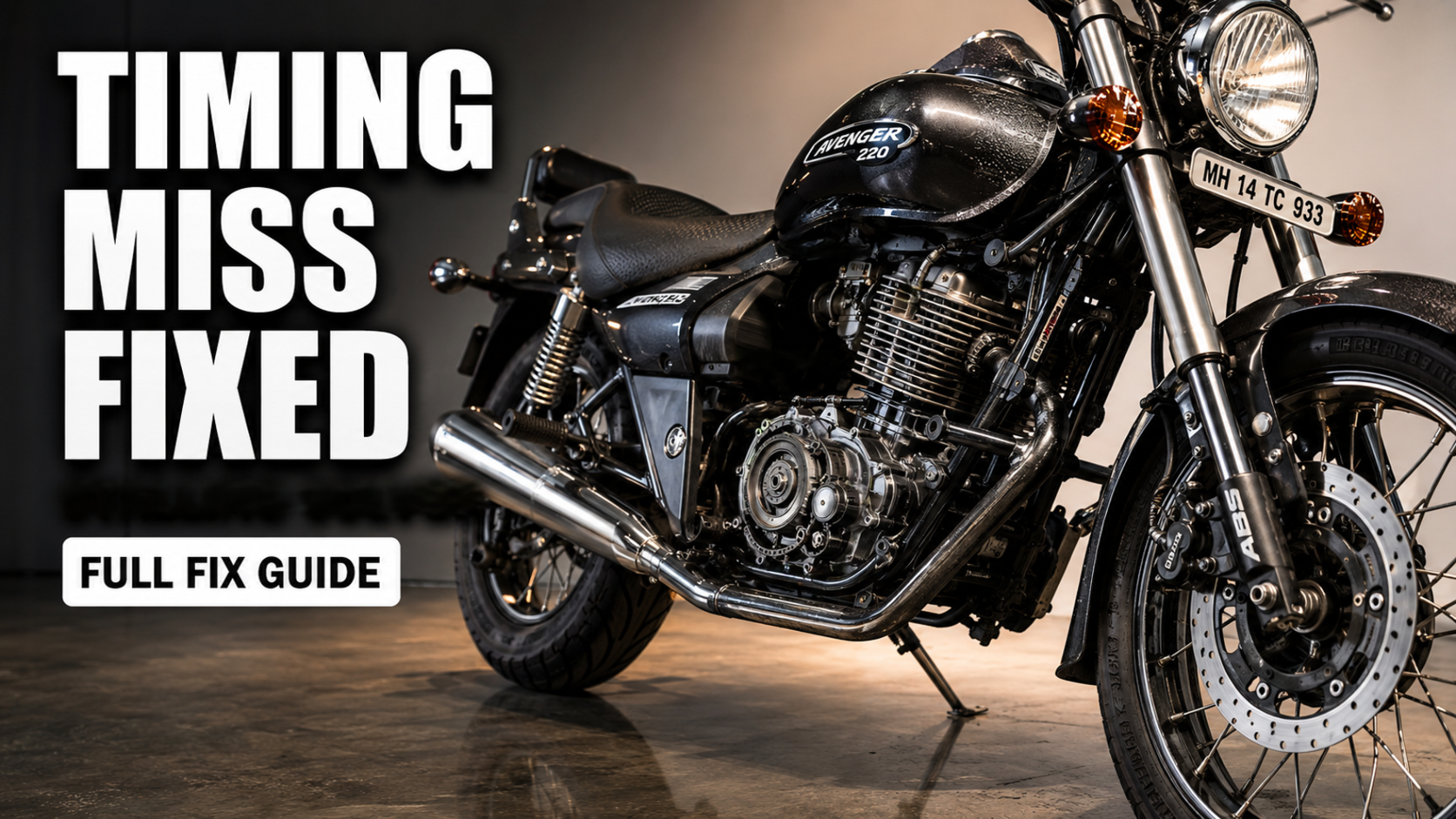

If your Bajaj Avenger 220 dies the moment you blip the throttle, or won’t hold idle unless the choke is pulled, the problem is almost never the one thing your mechanic changed first. Riders spend money on spark plugs and get maybe a 10% improvement, because the plug is a symptom, not the cause. The four faults that actually strand Avenger 220 owners are a lean pilot circuit, a failing side stand safety switch, overheated clutch plates, and a worn one-way starter clutch (the sprag clutch). One of them costs ₹0 to rule out. Below is a symptom-to-cause map no single forum thread gives you, split cleanly between the carbureted bikes and the BS-VI fuel-injected models from 2020 onward, because they fail for different reasons.
| Symptom | Most likely cause | Fix | Est. cost (₹) (INR) |
|---|---|---|---|
| Needs choke every start, even when warm | Lean pilot jet / idle mixture off | Carb clean + pilot screw reset | 600 to 1,200 |
| Stalls randomly, often mid gear-change | Side stand safety switch | Tape-test, then replace switch | 350 to 700 |
| Power sags at 40 to 50 kmph, returns after seconds | Clutch plates slipping when hot | Clutch plate set + oil | 1,500 to 3,000 |
| Self-start dead, kick works, battery is fine | One-way starter (sprag) clutch | Sprag clutch replacement | 2,500 to 5,000 |
Why does my Avenger 220 need the choke every single start?
If the bike will only idle with the choke pulled, even after it’s warm, the pilot (idle) circuit in the carburettor is running too lean. On a carbureted Avenger 220 the choke enriches the mixture, so a permanent choke dependency means the fuel side of idle is starved: a partially clogged pilot jet, a wrong pilot screw setting, or a float level sitting too low.
There’s a clean diagnostic split here that most owners miss. Choke needed on a cold start only, then off within a minute or two, is normal carburettor behaviour on this engine. Nothing is wrong. Choke needed on every start, warm or cold, or the engine dying the second you push the choke off, points at the pilot circuit.
A good workaround is the two-minute warm idle plus a gentle throttle blip to keep it alive, and some riders bump-start to get moving. Treat that as a limp-home trick, not a repair. The real fix is pulling the carb, cleaning the pilot jet with carb cleaner and compressed air, and resetting the air-fuel screw. A shop typically charges ₹600 to ₹1,200 for the clean and tune. Air filter condition matters too: a choked filter makes the whole thing worse and is a ₹300-ish part.
Why does my Avenger 220 die or stumble when I twist the throttle?
A sudden stumble or cut-out under acceleration on the Avenger 220 is usually a mixture that goes lean the instant you open the throttle, not ignition timing, despite the “timing miss” feel every rider describes. When you snap the throttle open, the carb has to dump extra fuel fast. If the fuel side can’t keep up, the engine bogs, coughs, or stalls.
This is why a spark plug swap gives such a small gain. Owners for this exact bike report roughly 10% improvement from a fresh plug, because the plug treats fouling (a downstream effect) while the lean mixture keeps causing it. Cleaning the plug helps for a week, then you’re back.
Check these in order of likelihood:
- Float level too low, so the fuel bowl starves under load.
- Idle/pilot screw set too lean (same screw as the choke problem above).
- Air filter clogged, tipping the mixture lean.
- Fuel line or tank vent restricted, so fuel can’t flow fast enough. A quick test: open the fuel cap and see if the stumble improves, which suggests a blocked tank vent.
If the miss only shows up under load and never at idle, put the carb and fuel delivery at the top of the list before you spend a rupee on ignition parts.
Can a bad side stand safety switch make the bike stall while riding?
Yes. On many Avenger 220 units a failing side stand safety switch cuts the ignition intermittently, and it most often triggers during gear changes or over bumps, because the switch plunger loses contact for a fraction of a second. This is a documented, repeatable failure pattern reported across xBhp and Team-BHP Avenger threads, and it’s the single most misdiagnosed stall on the bike.
The side stand switch is a safety cut-off. It kills the engine if the side stand is down while the bike is in gear. When the switch itself goes flaky, the bike behaves as if the stand keeps dropping, even though it’s fully up.
Here’s the part that saves you money: you can rule this in or out for ₹0 before buying anything. The switch is a real, replaceable part side stand safety switch, priced around ₹350 to ₹700, but you test it first with tape.
The ₹0 side-stand-switch bypass test (do this before you pay anyone)
- Park on the main (centre) stand so the bike is stable and the rear wheel is off the ground.
- Find the side stand switch: it’s a small black sensor mounted at the side stand pivot on the left of the frame, with a two-wire connector.
- Lift the side stand fully up. Using strong tape or a zip tie, hold the stand firmly in the up position so the switch plunger stays pressed in and can’t wobble.
- Start the bike and ride your usual route, the one where it normally stalls. Change gears deliberately and go over the same bumps.
- If the random stalling stops completely, your side stand switch is the culprit. Replace it. If it still stalls, the switch is cleared and you move to the clutch or sprag clutch below.
Do not ride long-term with the switch taped or bypassed. It’s a safety device. Use the test to confirm the fault, then fit a new switch.
Power drops at 40 to 50 kmph and comes back. Is that the clutch?
If the bike loses pull at 40 to 50 kmph under sustained throttle and then recovers after a few seconds, the clutch plates are slipping when they get hot, not a fuel problem. Owner reports put this failure most often after roughly 10,000 km, when the friction plates have worn or the clutch has been ridden hard in city traffic.
The tell is how the power loss behaves. Clutch slip feels like the engine revs climbing while road speed doesn’t, and it eases when the plates cool. Fuel-delivery hesitation feels like a stumble or miss tied to throttle position, and it’s there hot or cold. Slip is heat-dependent and progressive; a fuel miss is not.
A worn clutch plate set replacement runs about ₹1,500 to ₹3,000 fitted, including clutch oil. If you’re already at 25,000 km-plus and the bike has lived in stop-go traffic, budget for this as wear-and-tear, not a defect. Check the clutch cable free play first, because an over-tight cable can hold the plates partly disengaged and mimic slip for free.
Self-start fails but the kick works. Is the one-way starter clutch gone?
When the electric self-start whirs or clicks without turning the engine, but the kick-start fires it up fine and the battery reads a healthy 12.5V-plus, the one-way starter clutch (the sprag clutch) is the prime suspect. This is a documented recurring failure on the Avenger 220 and its Pulsar-family siblings that share the engine, reported across multiple owner complaints.
The sprag clutch is a one-directional bearing that lets the starter motor spin the crank, then disengages once the engine catches. When it wears, the starter motor spins but no longer grips the crank, so nothing happens, or you hear a grinding whir. A fresh battery won’t fix it, and neither will a new starter motor, which is exactly why this one drains wallets.
Now the uncomfortable truth, and it’s the reason to read this before your third service visit. Bajaj authorised service centres frequently fail to diagnose the sprag clutch on the first attempt. Owners routinely report 3 to 4 trips, with the battery, starter relay, and starter motor swapped first, before someone finally opens the case and finds the worn one-way clutch. If your self-start is dead, the kick works, and the battery tests good, say the words “one-way starter clutch” to your advisor up front. It can save you two wasted visits. A sprag clutch replacement typically costs ₹2,500 to ₹5,000 with labour, because the engine case has to come apart.
BS-VI Avenger 220 (2020+): Why fuel injection changes the whole fault tree?
Everything above assumes a carburettor. The BS-VI Avenger 220, sold from 2020 onward, uses fuel injection with an ECU and sensors, so it stalls for a completely different set of reasons and the carb advice does not apply. Do not clean a pilot jet on a fuel-injected bike; there isn’t one.
On the injected bikes, idle and stalling faults usually trace to a sensor or the throttle body: a dirty throttle body causing a rough or hunting idle, a faulty idle air control behaviour, a failing throttle position sensor, or an oxygen-sensor reading that pushes the ECU to a bad mixture. Cold-start choke doesn’t exist here either; the ECU handles enrichment automatically, so if a BS-VI bike needs “choke-like” babysitting, that’s an ECU or sensor fault, not a rider technique.
The honest limitation: the exact fuel-delivery hardware and sensor list varies by trim and model year, and Bajaj’s public spec sheets are thin on this.
The practical move on a BS-VI bike is to read the fault codes before touching anything, which you can do with an OBD-style scanner.
The full diagnostic triage table: match your exact symptom
This is the table no single forum thread gives you. Find the row that matches how and when your Avenger 220 misbehaves, then follow the DIY check before spending money. Confidence reflects how many independent owner reports line up behind each cause.
| Symptom | When it happens | Likely cause | DIY check (free or cheap) | Est. fix cost (₹) (INR) | Confidence |
|---|---|---|---|---|---|
| Needs choke every start, warm or cold | At startup, every time | Lean pilot jet / idle mixture (carb only) | Note if warm-start also needs choke; check air filter | 600 to 1,200 | High |
| Dies / bogs on throttle blip | On acceleration, under load | Lean acceleration mixture, float level, tank vent | Open fuel cap and retest; inspect air filter | 600 to 1,500 | High |
| Random stall, no warning | Mid gear-change, over bumps | Side stand safety switch | Tape the stand up and ride (₹0 test) | 350 to 700 | High |
| Power sags then returns | 40 to 50 kmph, sustained throttle | Clutch plates slipping when hot | Check clutch cable free play first | 1,500 to 3,000 | Medium to High |
| Self-start dead, kick works | On starting, battery healthy | One-way starter (sprag) clutch | Test battery at 12.5V+; if good, suspect sprag | 2,500 to 5,000 | Medium to High |
| Rough / hunting idle, stalls | BS-VI bikes (2020+), any time | Throttle body, TPS, O2 or other sensor | Scan for fault codes first | Check at Service Centres | Medium |
Is the Avenger 220 actually reliable, or should you just sell it?
For most owners the Avenger 220 is a reliable, easy-going cruiser that’s cheap to run, and the stalling faults above are age-and-mileage wear items, not a sign the bike is junk. The 220cc DTS-i single is a proven Bajaj engine shared across the Pulsar range, and parts are available at any Bajaj outlet nationwide. The bike’s weak points are well known and fixable.
- What are the common problems of Avenger bikes? The recurring ones owners report are the side stand switch stalling, clutch slip after 10,000 to 15,000 km of city use, the sprag clutch starting failure, rear suspension feeling soft under a pillion, and average braking on the older drum-plus-disc setups. None are safety-critical if maintained.
- Is the Avenger 220 good or bad? Good for relaxed highway cruising and comfort at a low price, weak if you want sharp handling or high-rev performance. It’s a torque-forward cruiser, so judge it as one.
- What are the common problems with Bajaj bikes generally? Across the range, riders most often cite electrical niggles (switches, sensors, connectors), consumable clutch wear in traffic, and inconsistent service quality between dealers rather than engine failures.
- Why did Bajaj discontinue the Avenger 220 Street? Bajaj trimmed the Avenger line-up over time and narrowed it to the Cruise as demand shifted, and tightening BS-VI emissions economics made some low-volume variants unviable to keep.
When to stop DIY-diagnosing and hand it to a mechanic
Stop and get professional help immediately if the bike won’t self-start or kick-start at all, if you smell raw petrol or see fuel pooling under the carb, or if there’s a knocking noise from the engine. Those are compression, fuel-leak, or internal faults where continued cranking can make things worse or start a fire. Don’t keep hitting the starter hoping it clears.
Hand it over, don’t DIY, if the fault is the sprag clutch or the clutch plates, because both need the engine or clutch cover opened, torque specs, and a clutch holding tool. This isn’t a roadside job, and a half-done clutch reassembly can leave you stranded worse than before.
And the line a dealer won’t tell you: if your self-start is dead and you’ve already been told “it’s the battery” or “it’s the starter motor” once and it didn’t fix it, insist they inspect the one-way starter clutch before you approve a third part swap. Owners lose real money to this exact misdiagnosis loop. Get the diagnosis in writing before you pay.
FAQ
Why does my Avenger 220 need choke every time I start it?
Because the pilot (idle) circuit in the carburettor is running lean, usually a partly clogged pilot jet or a wrong air-fuel screw setting. Cold-start choke that switches off within a minute is normal; needing choke when the engine is already warm is the fault. A carb clean and pilot screw reset (around ₹600 to ₹1,200) is the fix, not a new spark plug.
Why does my Avenger 220 lose power on sudden throttle?
The mixture goes lean the instant you open the throttle, so the engine bogs or cuts. Check float level, the idle screw, the air filter, and the fuel tank vent before touching ignition parts. A fresh spark plug only gives about a 10% gain because it treats the fouling, not the lean cause.
Can a bad side stand switch make a motorcycle stall while riding?
Yes. A failing side stand safety switch intermittently cuts the ignition, most often during gear changes or over bumps, because the switch loses contact. Confirm it for ₹0 by taping the side stand fully up so the switch stays pressed and riding your usual route. If the stalling stops, replace the switch (about ₹350 to ₹700).
How much does it cost to fix an Avenger 220 starting problem in India?
It depends on the cause. A carb clean is roughly ₹600 to ₹1,200, a side stand switch ₹350 to ₹700, a clutch plate set ₹1,500 to ₹3,000, and a one-way starter (sprag) clutch ₹2,500 to ₹5,000 fitted. All figures are estimates.
My self-start is dead but the kick works. What is it?
If the battery tests healthy at 12.5V or more and the kick fires the engine, the one-way starter (sprag) clutch is the most likely cause. Ask your service advisor to check it directly, because it’s commonly misdiagnosed as a battery or starter-motor fault first.