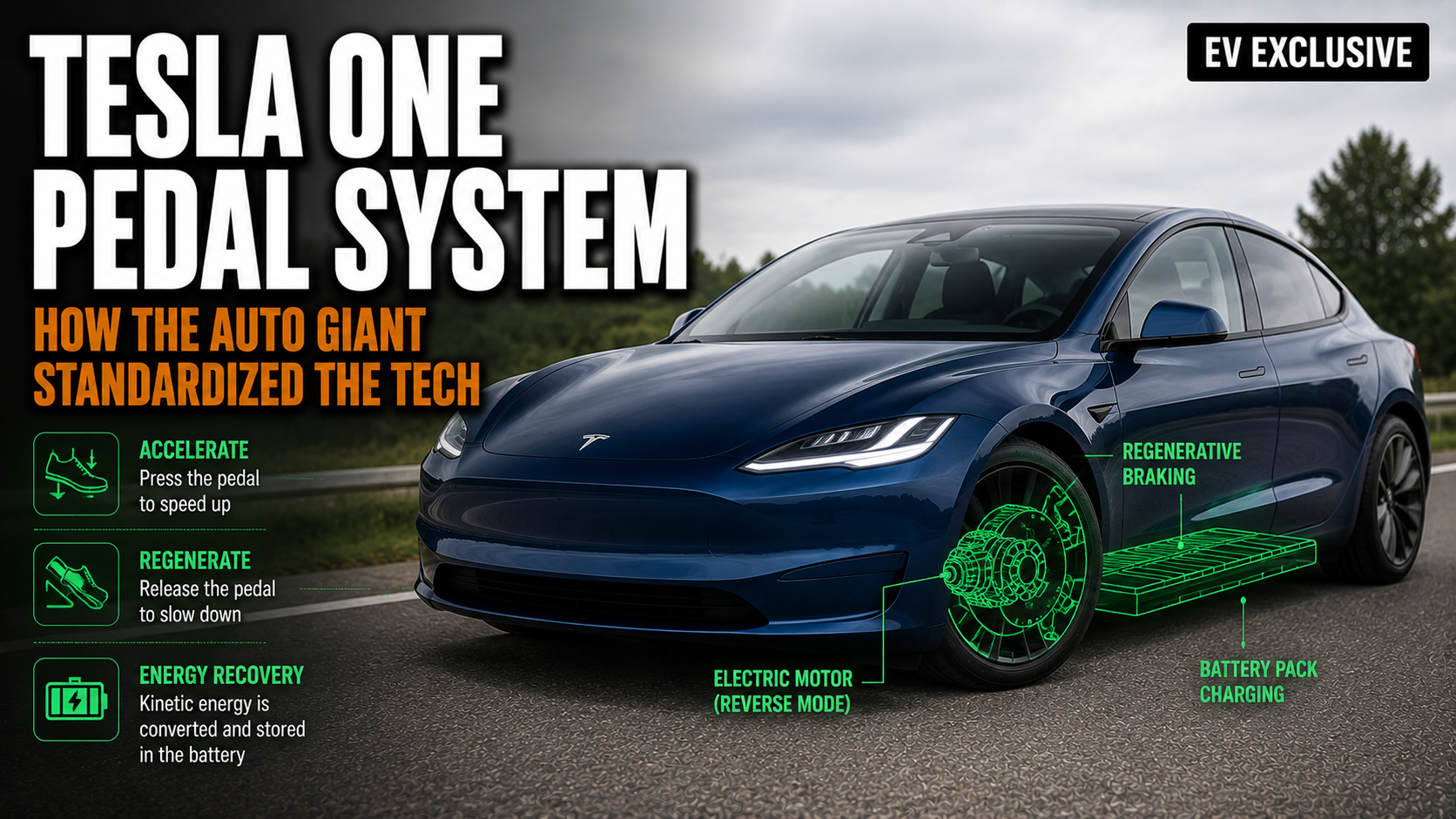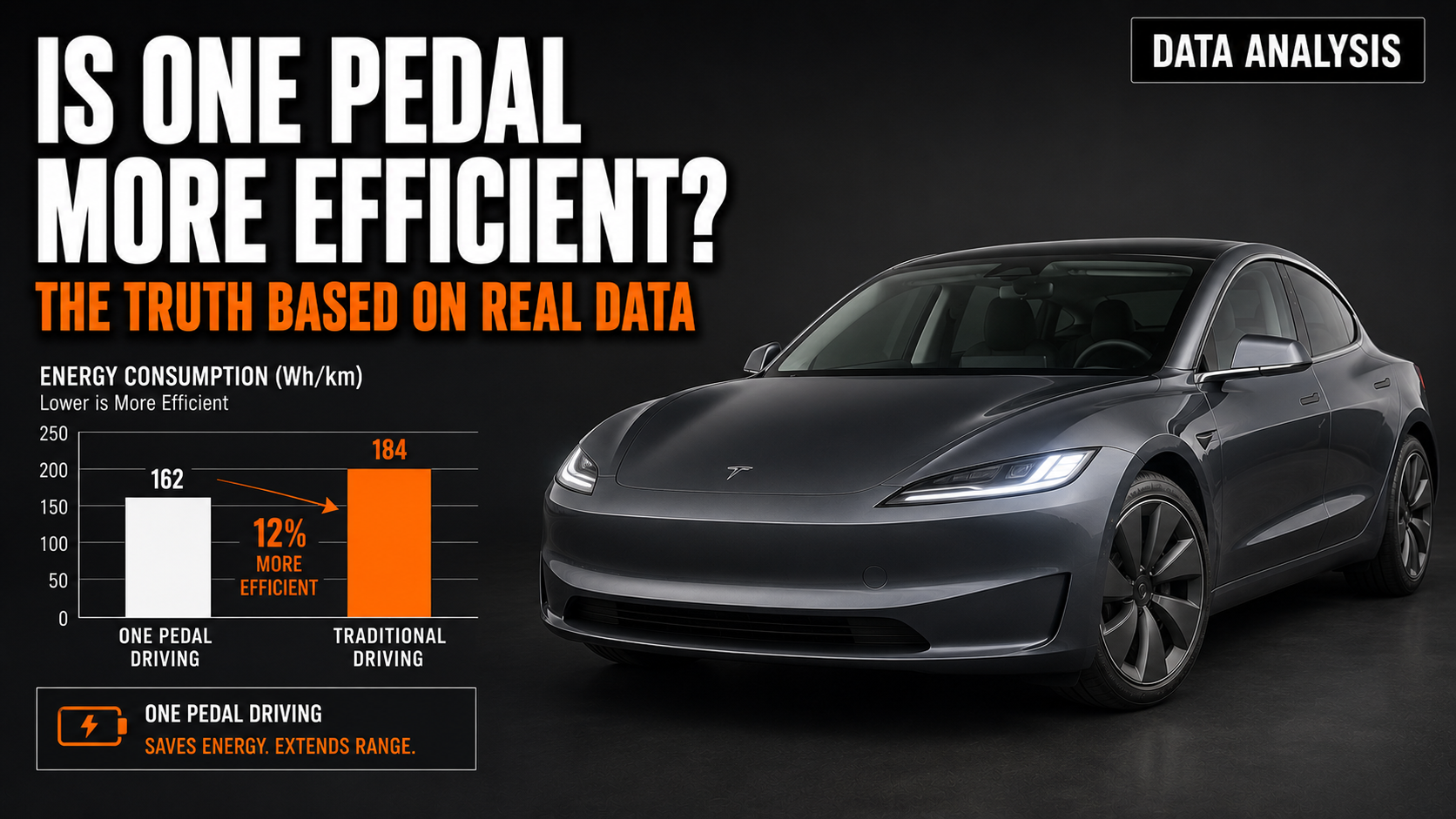

One pedal driving is more efficient only when it helps you replace friction braking with regenerative braking. It is usually helpful in city traffic, school lines, parking garages, and stop-and-go commutes. It is not automatically more efficient on the highway, because coasting preserves vehicle momentum while regeneration converts motion into electricity and then back into motion later.
The short version: one pedal driving mode is a control style. Regenerative braking is the energy-saving technology. A smooth driver using blended brake regen can be just as efficient as a smooth driver using one pedal mode.
When one pedal driving wins
| Driving situation | Best mode for efficiency | Why | Driver mistake that wastes energy |
|---|---|---|---|
| Stop-and-go city commute | One pedal driving or high regen | Frequent slowdowns give the car many chances to recover energy. | Accelerating hard, lifting off hard, then repeating. |
| Flat freeway at steady speed | Coast, light regen, or cruise control | The most efficient slowdown is often no slowdown. | Using strong regen every time traffic opens and closes slightly. |
| Downhill grade | Moderate regen or route-aware regen | Regen can control speed while sending some energy back to the battery. | Letting speed rise, then making a late hard stop. |
| Cold morning or 100% battery | Be ready for weaker regen | The battery may not accept as much recovered energy. | Expecting the same stopping force as yesterday. |
Is one pedal driving more efficient than normal driving?
One pedal driving is more efficient than normal driving when “normal” means using friction brakes for slowdowns that could have been handled by regenerative braking. It is not more efficient than a well-tuned blended brake system that already uses regen when you press the brake pedal.
This distinction is where most online arguments go sideways. Many EVs recover energy in two ways: lift-off regen from the accelerator and brake-pedal regen through blended braking. Car and Driver notes that automakers use different strategies, with some putting regen mostly in accelerator lift-off, some blending most regen into the brake pedal, and many doing both.
The best comparison is not one pedal driving vs two pedals. The useful comparison is regen vs friction brakes. If two-pedal mode uses the brake pedal to request regen first, then one pedal mode may not add much energy recovery. It may simply change how the driver asks for the same deceleration.
Road & Track reached a similar practical conclusion after comparing different EV approaches. Tesla’s strong lift-off regen can be efficient because pressing the brake pedal mostly uses the hydraulic brakes in that design, while many other EVs can use regen from the brake pedal too. That means the answer depends on the car.
The data: regen helps, but coasting still matters
Regenerative braking recovers energy that friction braking would waste as heat. It does not recover 100% of the vehicle’s motion. Any time motion becomes electricity, moves through power electronics, enters a battery, leaves the battery, and becomes motion again, losses occur.
Mazda’s regenerative braking explainer cites U.S. Department of Energy estimates that regenerative braking energy recovery is 5% to 9% for hybrids and 22% for electric vehicles in combined city/highway driving Source: Mazda USA. That is a meaningful gain. It also shows why regen is not a magic answer to every efficiency question. The gain comes when the car needs to slow down.
Here is the plain physics:
| Action | Energy path | Efficiency implication |
|---|---|---|
| Coasting | Motion stays as motion until drag and rolling resistance reduce it. | Best when you can keep moving without needing to slow much. |
| Regenerative braking | Motion becomes electricity, then stored battery energy. | Best when traffic, grade, or stops require slowing anyway. |
| Friction braking | Motion becomes heat at pads and rotors. | Least efficient for routine slowdowns, still needed for hard stops. |
GreenCars summarizes Porsche’s coasting argument: coasting keeps kinetic energy in the vehicle, while immediate aggressive regeneration captures that energy and then later converts it back to propulsion, creating two rounds of losses. That is why one pedal driving can feel efficient in traffic and still lose to coasting on a clear highway.
Is one pedal driving more efficient on the highway?
One pedal driving is usually not the most efficient highway setting unless traffic is constantly slowing. On a steady freeway, the car does not need repeated braking. Strong lift-off regen can make the driver scrub speed too often, then spend battery energy to regain that speed.
Road & Track quotes Polestar’s view that one-pedal driving can be less efficient on the highway because it makes maintaining constant speed harder without cruise control. GreenCars makes the same highway case through Porsche’s strategy: the Taycan defaults to coasting because the vehicle can roll a long distance with little speed loss at highway pace.
The highway rule is simple. If you can hold speed or gently coast with traffic, strong one pedal mode is not helping. If traffic slows sharply every few seconds, regen helps because you must slow anyway.
Cruise control changes the question. If radar cruise manages speed smoothly, the exact regen setting may matter less because the car controls the power and deceleration requests. Some newer EVs also use route-aware regen, cameras, radar, navigation data, and grade information to decide when to coast and when to regenerate.
Does one pedal driving increase range in the city?
One pedal driving can increase city range because city driving has repeated braking events. Every stoplight, crosswalk, traffic queue, and parking-lot slowdown is a chance to recover energy that a gas car would lose as brake heat.
Mazda says one-pedal mode is particularly useful in urban areas where the driver frequently switches between accelerating and braking. Chevrolet says One-Pedal Driving can slow and stop an EV under normal conditions and has Normal and High settings on the Equinox EV.
The range benefit still depends on driver behavior. A careful driver who anticipates lights and eases off early will get more benefit than a driver who launches hard from every stop and then uses maximum regen at the last second. Regen is better than friction braking. Avoiding unnecessary speed changes is better than needing regen in the first place.
For commuters, the best use is moderate, predictable lift-off. If the car lets you pick levels, start with medium regen and watch the energy display. The efficient pattern is a long, smooth deceleration that avoids the brake pedal until the last few feet, or avoids it entirely when safe.
One pedal driving brake lights: the overlooked safety variable
One pedal driving brake lights are not as simple as “foot off means lights on.” Brake-light behavior depends on the vehicle, software, and deceleration level. In the U.S., there is no universal rule requiring brake lights for every regenerative-braking event.
Mazda notes that the U.S. has no standard brake-light requirement for all types of regenerative braking, while Europe uses a deceleration threshold for brake lights. Mazda also notes that some vehicles may not illuminate brake lights if the accelerator has even slight pressure on it.
This matters because skilled one pedal drivers often keep light pressure on the accelerator while slowing smoothly. From inside the car, that feels controlled. From behind the car, the signal may vary by model.
Consumer Reports tested EV brake-light behavior and reported that some Hyundai, Kia, and Genesis vehicles did not illuminate brake lights during rapid one-pedal deceleration unless the driver fully released the accelerator. That finding does not apply to every EV, but it is enough reason to test your own car.
Practical test: at night, use a garage door, storefront reflection, or a helper. Drive slowly in a safe area with one pedal driving mode on. Ease off gently, then lift off more firmly. Check when the brake lights come on. If your car gives unclear signals during gentle slowing, use the brake pedal sooner when traffic is close behind.
What are the disadvantages of one-pedal driving?
The main disadvantages of one-pedal driving are passenger discomfort, weaker coasting, changing brake-light behavior, reduced regen when the battery is cold or full, and overconfidence in a mode that cannot replace emergency braking.
Chevrolet says One-Pedal Driving is not recommended for slippery roads such as wet, snowy, or icy roads, and steep hills may require more frequent brake-pedal use. A Chevrolet Silverado EV quick reference document also says regenerative braking and One-Pedal Driving may be limited when the propulsion battery is near full charge or cold.
Mazda gives a broader safety limit: regenerative braking cannot replace friction brakes for emergency braking at higher speeds, and the two braking types are meant to work together. That is the sentence every new EV driver should keep in mind.
The daily annoyance is smoothness. Strong one pedal mode punishes abrupt foot movement. Your passengers may feel every tiny change in ankle pressure. If the car feels jerky, lower the regen level and practice gradual lift-off.
When should you use one pedal driving mode?
Use one pedal driving mode when traffic requires repeated slowing and stopping. Turn it down or off when you want to coast, drive on slick roads, maintain steady highway speed, or let passengers ride more comfortably.
| Use one pedal mode | Use lower regen or coast |
|---|---|
| Downtown traffic with frequent lights | Open freeway with stable speed |
| School pickup or drive-through line | Snow, ice, standing water, or loose gravel |
| Downhill city streets where speed needs control | Passengers complain about head movement |
| Parking garages and low-speed queues | Battery is full or cold and regen feels weaker |
For a first week with a new EV, use one pedal mode as a training exercise, not a badge of skill. Start on local roads. Leave extra following distance. Watch the energy display. Then try a highway run with cruise control, a run with low regen, and a run with strong regen. The car will teach you where the setting helps.
Is one-pedal drive worth it?
One-pedal drive is worth it if your commute includes frequent slowdowns and you like the feel. It is less useful if you drive mostly highway miles, prefer coasting, or own an EV with excellent blended brake regen.
The comfort gain may matter more than the range gain. In heavy traffic, one pedal mode reduces pedal switching and lets you control small speed changes with one foot. In a vehicle that handles brake lights clearly and has predictable regen, that can make a commute calmer.
The range gain is situation-dependent. The strongest efficiency rule is still boring: keep speed steady, look far ahead, avoid hard launches, avoid hard stops, precondition while plugged in, and use climate control thoughtfully. Chevrolet’s Silverado EV guide gives the same practical advice: speed up smoothly, use regenerative braking instead of rapid stops, and drive at posted speed limits because higher speeds use more energy.
Not for you
One pedal driving is not the best default if you are trying to maximize highway range on a clear road. In that case, coasting or radar cruise may be cleaner than turning every lift-off into deceleration.
It is also not a great fit if your passengers feel sick, your local roads are icy, or your car’s brake lights behave oddly during partial accelerator lift. A mode that saves a few watt-hours while making following drivers guess is not a good trade.
One more blunt point: if you use one pedal mode as a substitute for looking ahead, it will not make you efficient. It will make you jerky.