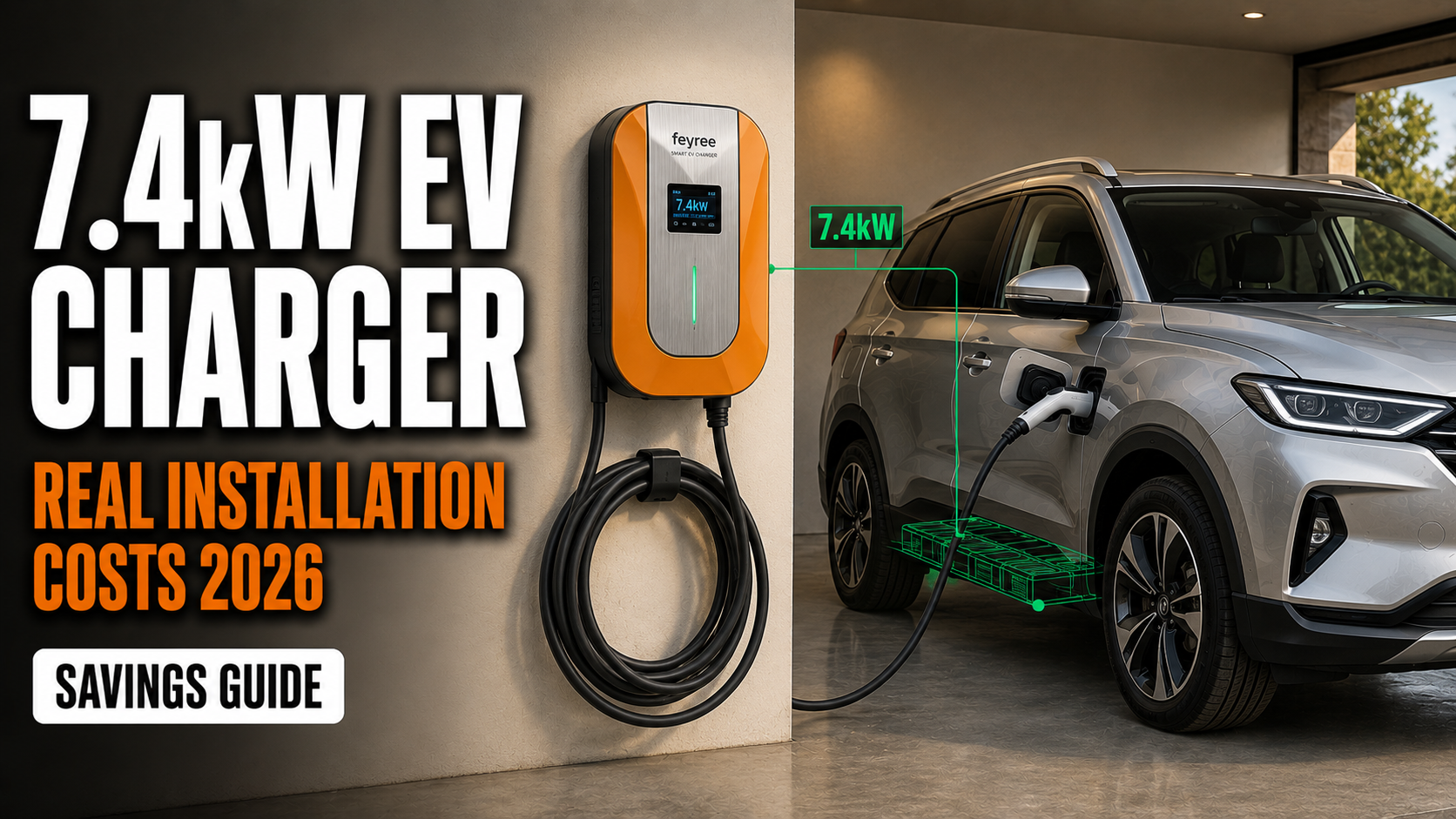

A 7.4 kW home EV charger in India usually costs INR 35,000 to INR 90,000 fully installed in 2026. The charger unit is only one part of the bill. The real price depends on cable distance from the meter, whether your home can support a 32A continuous load, whether you need an EV meter or sanctioned-load upgrade, and whether your parking slot is in an apartment basement, stilt, open bay, or private house.
The cheapest clean setup is a wallbox near the meter with existing spare load. The expensive setup is a dedicated apartment parking bay 25 to 40 metres away from the electrical room, with fresh copper cable, conduit, MCB/RCD protection, earthing work, permissions, and metering.
Cost summary
| Cost item | Typical 2026 cost in India | When it rises |
|---|---|---|
| 7.4 kW wallbox unit | INR 27,000 to INR 50,000 | OCPP, 4G, RFID, better enclosure, longer cable, bundled support |
| Installation labour | INR 2,500 to INR 10,000 | Long cable run, basement work, wall drilling, certified installer visit |
| Cable, conduit, isolator, MCB/RCD, earthing | INR 8,000 to INR 35,000 | Parking is far from meter, cable route needs conduit/tray, earthing is weak |
| Sanctioned-load or meter work | INR 0 to INR 25,000+ | Existing load is 3 kW to 5 kW, apartment needs EV meter, DISCOM asks for service-line upgrade |
| Full installed cost | INR 35,000 to INR 90,000 | Long apartment run, new meter, load upgrade, civil work, premium smart charger |
How much does it cost to install a 7.4 kW charger?
The honest budget for a 7.4 kW home charger is INR 35,000 to INR 90,000, with some apartment installations crossing INR 1 lakh when the parking slot is far from the meter room. A villa owner with a short cable route may spend less than an apartment owner who needs RWA approval, dedicated metering, armoured cable, and fresh earthing.
The unit price has become easier to check. ORBLR lists its CYBR7 7.4 kW charger at INR 26,999 and shows optional installation service at INR 2,999, with cable, MCB, conduit and accessories charged separately. RIOD lists its PowerPod Lite 7.4 kW single-phase Type 2 charger at INR 45,000 with a 5 m cable, RFID or automatic-start access, IP65 rating and 2-year warranty. Bolt.Earth says the Blaze AC 7.4 kW includes professional installation worth INR 2,499, with wiring charged separately.
The gap between INR 27,000 and INR 90,000 is mostly site work. A 7.4 kW charger pulls up to 32A on single-phase supply. Bolt.Earth lists its 7.4 kW unit at 220V AC single phase with maximum output current of 32A and Type 2 AC connector. That continuous current is why a proper installation uses a dedicated circuit, protective devices, sound earthing, and cable sized for the route. A normal-looking parking bay can become expensive when the cable has to cross a driveway, basement ceiling, fire zone, or common area.
What does a 7.4 kW EV charger need at home?
A 7.4 kW EV charger needs a dedicated 230V single-phase circuit that can safely carry around 32A for several hours. It also needs enough sanctioned load, good earthing, a suitable MCB/RCD or RCBO arrangement, weather protection if exposed, and a Type 2 connector for most electric cars sold in India.
This is the part many quotes hide under “installation extra”. The Alliance for an Energy Efficient Economy says an EV-ready home needs adequate sanctioned load, low-resistance earthing, appropriately rated wiring, safe charger placement, individual or legal metering, and a dedicated charging circuit protected by MCBs and RCDs. Those items are boring until one is missing. Then charging trips at night, the socket heats, the charger derates, or the society blocks the work.
The charger also has to match your car. Buying an 11 kW or 22 kW AC charger does not make a car charge faster if the car’s onboard AC charger accepts only 7.2 kW or 7.4 kW. For many Indian EV owners, 7.4 kW is the practical home ceiling because it works on single-phase power and fits overnight charging for a 30 to 45 kWh battery. A 22 kW AC charger makes sense only when the car supports it and the building has three-phase supply available at the parking bay.
How much is the 7.2 kW or 7.4 kW AC wallbox price?
In 2026, the visible online price for a 7.2 kW to 7.4 kW AC wallbox in India sits around INR 27,000 to INR 50,000 for home-focused products. Commercial or shared-access 7.4 kW chargers can cost more because they add OCPP, SIM connectivity, billing, RFID management, a heavier enclosure, or network support.
| Charger | Listed power | Visible price | Useful details | Main tradeoff |
|---|---|---|---|---|
| ORBLR CYBR7 | 7.4 kW single phase | INR 26,999 sale price | 6A to 32A adjustable current, app control, RFID, IP65, optional INR 2,999 installation service | Accessories such as cable, MCB, conduit and other parts are charged separately after inspection |
| RIOD PowerPod Lite | 7.4 kW single phase, 32A | INR 45,000 | Type 2 connector, 5 m cable, RFID or automatic-start access, IP65, Class 1 energy meter, 24-month warranty | No Wi-Fi, no 4G, no OCPP; better for private bays than shared billing |
| Bolt.Earth Blaze AC | 7.4 kW single phase, 32A | {{VERIFY: current checkout price, confirm on Bolt.Earth product page at purchase time, https://bolt.earth/ev-charging-products/4-wheeler-chargers/blaze-ac-7kw}} | Type 2 AC connector, OCPP 1.6J, Wi-Fi, optional 4G/Ethernet, IP56, 2-year warranty, Type B earth leakage protection | Page states wiring charges apply separately, so installed price depends on site |
| OEM bundled charger | Usually 3.3 kW, 7.2 kW or 7.4 kW depending on vehicle | INR 0 to INR 75,000 depending on car brand, variant and package | May be included, subsidised, or sold as an accessory by the vehicle maker | {{VERIFY: exact OEM accessory price for Tata, Mahindra, MG, Hyundai, BYD or Kia model, confirm with dealer invoice before publication, dealer quote}} |
The smart choice is rarely the cheapest unit alone. For a private house, a simple automatic-start or RFID unit may be enough. For an apartment where the charger sits in a common basement, RFID, lockable access, energy metering, and weather or dust protection matter more. For a society charger shared by multiple residents, OCPP and billing support become more useful than a lower sticker price.
Why wiring distance changes the bill so much
Cable distance is the biggest swing factor after the charger itself. A 5 m run from the distribution board to a garage wall can be cheap. A 30 m apartment basement run with conduit, bends, wall drilling, cable tray and protection can cost more than the visible installation fee on the charger website.
There are two distances to check. The first is the physical distance from your meter or distribution board to the charger location. The second is the actual cable route, which may be longer because it has to follow walls, shafts, basement ceilings, or society-approved pathways. A bay that looks 12 m away can need 20 m of cable once the electrician avoids doors, fire equipment, water pipes and vehicle movement zones.
Do not compare quotes unless they include the same route. One quote may include only mounting and termination. Another may include copper cable, conduit, MCB, isolator, RCCB/RCBO, earthing check and commissioning. A third may include a new EV meter application and site visit coordination with the DISCOM. These are different jobs.
For a 7.4 kW charger, ask the installer to write these line items: cable length and size, cable type, conduit or tray length, MCB rating, RCD or RCBO type, isolator, earthing work, waterproof box if outdoors, drilling or civil work, labour, GST, and warranty on installation. If the quote says “standard installation” without distance, assume only a short run is included.
Do you need a sanctioned-load upgrade for a 7.4 kW charger?
You need a sanctioned-load check before installing a 7.4 kW charger because the charger alone can draw 7.4 kW at full output. If your home has a 3 kW, 5 kW or 6 kW sanctioned load and you run ACs, geysers, induction cooking or pumps at the same time, your meter or protection may trip unless the charger current is limited or the sanctioned load is raised.
This is where adjustable-current chargers earn their keep. A charger that can be set from 6A to 32A lets you charge slower on weak supply and faster when the house load is low. ORBLR lists adjustable current between 6A and 32A on the CYBR7. Bolt.Earth lists load-balancer support for its Blaze AC 7.4 kW unit.
The practical test is simple. Add your EV charger power to the heavy appliances you may run together at night. A 7.4 kW charger plus a 1.5-ton AC, geyser, fridge, lights and kitchen load can cross a typical small sanctioned load quickly. You can still install the charger and cap it at 16A or 20A, but then you are paying for 7.4 kW hardware while using it closer to 3.7 kW to 4.6 kW on many nights.
Apartment owners have one more layer: the building’s common electrical capacity. A society may permit one or two chargers, then pause approvals until load sharing, new meters, or upstream capacity are sorted. The AEEE 2026 note flags apartment complexes, common-area capacity, unclear responsibilities and coordination gaps with DISCOMs as real barriers to residential charging.
What is the cost of charging an EV at home in India?
The cost of charging at home is battery capacity multiplied by your electricity tariff. The Bureau of Energy Efficiency gives the same formula: battery capacity in kWh x EV charging tariff in INR/kWh, with state tariffs varying by location.
Use this as your first estimate:
| Battery size | At INR 4.5/kWh | At INR 7/kWh | At INR 10/kWh | Typical use case |
|---|---|---|---|---|
| 25 kWh | INR 113 | INR 175 | INR 250 | Small city EV or compact electric hatch |
| 35 kWh | INR 158 | INR 245 | INR 350 | Common compact SUV or crossover size |
| 45 kWh | INR 203 | INR 315 | INR 450 | Larger city and highway-capable EVs |
| 60 kWh | INR 270 | INR 420 | INR 600 | Premium EVs and larger battery packs |
Delhi is the cleanest example of a dedicated EV tariff because the Residential EV Charging Guidebook lists EV meter energy charges at INR 4.5/kWh, with separate metering, SLD and security-deposit examples. In many other states, owners charge through the domestic meter and pay the domestic slab rate unless a separate EV tariff applies.
Public charging changes the math. The Ministry of Power’s 2024 framework for public and community stations includes time-based charging fees for public/community stations: AC charging at INR 3 per unit during solar hours and INR 4 per unit during non-solar hours, with DC charging at INR 11 and INR 13 respectively. Private networks may still charge higher user-facing prices once service fees, platform fees, taxes, parking, or operator margins are added.
How long does a 7.4 kW charger take to charge a car?
A 7.4 kW charger adds up to 7.4 kWh per hour before charging losses and vehicle limits. In practical terms, a 35 kWh battery can take around 5 to 6 hours from low to full, and a 45 kWh battery can take around 6 to 8 hours. Charging from 20% to 80% is faster because you are adding only 60% of the battery, not the full pack.
| Battery size | Energy from 20% to 80% | Ideal time at 7.4 kW | More realistic time with losses |
|---|---|---|---|
| 25 kWh | 15 kWh | About 2 hours | 2.2 to 2.5 hours |
| 35 kWh | 21 kWh | About 2.8 hours | 3.1 to 3.5 hours |
| 45 kWh | 27 kWh | About 3.6 hours | 4 to 4.5 hours |
| 60 kWh | 36 kWh | About 4.9 hours | 5.5 to 6.2 hours |
This timing assumes the car accepts the full 7.4 kW on AC. Some EVs come with a lower onboard AC charger and will charge slower even when connected to a 7.4 kW wallbox. The BEE FAQ gives a useful public reference point: an electric car with around a 30 kWh battery can reach 80% in less than 1 hour on a 50 kW fast charger, while a slow/moderate 15A plug takes around 8 hours for a similar percentage.
For daily use, the better question is how much you need to add overnight. If you drive 40 km a day and your EV uses 8 to 10 kWh for that distance, even a reduced-current overnight session can cover the next day. A 7.4 kW charger matters most when you return late with a low battery and need the car ready the next morning.
What changes in an apartment or housing society installation?
An apartment installation can cost more than a bungalow installation because the charger touches shared infrastructure. You may need written society approval, a dedicated or sub-metered line, a route through common areas, fire-safety clearance, and an agreement on who pays for future repairs to cable trays, meters, and common panels.
The Ministry of Power’s 2024 guidelines apply to EV charging infrastructure in private parking spaces and semi-restricted places such as group housing societies. The same policy direction supports residential charging, but the real process still runs through your DISCOM, state rules, and society management.
Delhi’s Residential EV Charging Guidebook gives unusually practical details for societies. It says the single-window process covered AC 001, LEV AC and DC 001 chargers, gave a 100% subsidy up to INR 6,000 for the first 30,000 charging points, and allowed an LEV AC charger for as low as INR 2,500 under the scheme. That is useful for Delhi, not a national price for every 7.4 kW car wallbox.
For a 7.4 kW car charger, apartment owners should ask the society for four approvals in writing: cable route, metering method, charger location, and maintenance responsibility. If the charger will be in a basement or open parking area, ask whether the society requires a lockable enclosure, bollard protection, fire-rated cable route, or a separate isolator near the charger. These items are not sales extras. They decide whether the charger survives daily use.
Should you install a 7.4 kW charger or use a 15A socket?
Use a 7.4 kW wallbox if your car supports 7.2 kW to 7.4 kW AC charging, your parking spot is fixed, and you want reliable overnight charging from low battery. Use a 15A socket only for lighter use, backup charging, two-wheelers, or low daily running where slow charging is enough.
The wallbox wins on speed, safety control, cable management and daily convenience. It also gives you better protection features when installed properly. Bolt.Earth’s Blaze AC lists auto power cut-off, power theft protection, inbuilt energy measurement, over/under-voltage protection, over-temperature protection, emergency push button and Type B earth leakage protection . RIOD lists residual current, ground fault, surge, over-voltage, under-voltage and short-circuit protection on its PowerPod Lite.
A 15A socket can still be useful. It keeps initial cost low, and many EVs ship with a portable charger. The tradeoff is time. A low-current socket can take most of the night for a moderate battery top-up and much longer from low charge. The socket, plug and wiring also need to be in good condition because EV charging is a long-duration load, not a quick appliance burst.
If you are unsure, do the 30-day test. Track your daily kilometres, parking time at home, and how often the car returns below 30%. If the car sits parked for 10 to 12 hours and your daily use is small, a lower-current setup may work. If you do highway trips, late-night returns, or back-to-back driving days, the 7.4 kW wallbox becomes easier to justify.
What is the payback against public charging?
A home charger pays back faster when you replace high-priced public charging with domestic or dedicated EV tariff charging. If public charging costs INR 18/kWh and your home charging costs INR 7/kWh, you save INR 11 per kWh. A driver using 200 kWh per month saves about INR 2,200 per month, so a INR 60,000 installation pays back in roughly 27 months.
| Monthly home energy | Home tariff | Public tariff compared | Monthly saving | Payback on INR 60,000 setup |
|---|---|---|---|---|
| 100 kWh | INR 7/kWh | INR 18/kWh | INR 1,100 | About 55 months |
| 200 kWh | INR 7/kWh | INR 18/kWh | INR 2,200 | About 27 months |
| 300 kWh | INR 7/kWh | INR 18/kWh | INR 3,300 | About 18 months |
This payback ignores the softer benefit: time. If a public charger is 3 km away and you spend 25 minutes plugging in, waiting, paying and returning, the home charger saves that effort every week. It also removes uncertainty around broken plugs, blocked bays, app failures and queueing.
The payback is weaker if you drive little. If your EV uses only 50 kWh a month, a INR 70,000 installation can take years to recover through charging-cost savings alone. In that case, the charger is a convenience purchase. That is still valid, but it is a different decision.
The real 2026 installation checklist
Use this checklist before paying for the charger. It saves more money than bargaining over the wallbox price.
- Confirm the car’s onboard AC charging limit. If the car accepts only 3.3 kW, a 7.4 kW wallbox will not charge it at 7.4 kW.
- Check existing sanctioned load and night-time appliance use.
- Measure the real cable route from meter or distribution board to the parking bay.
- Ask for a written bill of quantities: cable, conduit, MCB, RCD/RCBO, isolator, earthing, waterproof box, labour and GST.
- Confirm whether the listed charger price includes a 5 m cable. RIOD lists a 5 m cable on PowerPod Lite.
- For apartment parking, get written approval for cable route, mounting point and metering method.
- Ask who handles DISCOM application if an EV meter or sanctioned-load upgrade is needed.
- Keep commissioning photos, test report, invoice and warranty documents.
The quote should read like electrical work, not like an accessory purchase. A 7.4 kW charger is a fixed high-load appliance. Treat it closer to a dedicated AC line than a phone charger.
When a 7.4 kW home charger is a bad fit
A 7.4 kW charger is a bad fit if you do not have dedicated parking, your society has no approved cable route, or your sanctioned load is too low and you cannot upgrade it soon. It is also a poor spend if your car’s AC onboard charger is capped at 3.3 kW and you rarely need faster charging.
One uncomfortable line: if your apartment committee only agrees verbally, do not install first and argue later. A disconnected charger and a damaged common-area wall can cost more than waiting for written approval.
There are also safety cases where delaying is wiser. If earthing is poor, the meter room is overloaded, the cable route crosses wet areas, or the installer wants to use a regular socket-style shortcut for a 32A continuous load, pause the job. A cheaper unsafe installation is not a saving.
FAQ
How much does it cost to install a 7.4 kW charger?
Most 7.4 kW home EV charger installations in India cost INR 35,000 to INR 90,000 in 2026. The lower end usually means a short cable run and existing spare load. The higher end usually means apartment work, long cable distance, fresh earthing, MCB/RCD hardware, EV meter work or sanctioned-load changes.
How much to install a 7.4 kW home charger?
Budget INR 27,000 to INR 50,000 for the charger unit and another INR 8,000 to INR 40,000 for installation-related work. If the website says “installation included”, read the fine print. Bolt.Earth includes professional installation worth INR 2,499 but says wiring charges apply separately. ORBLR lists optional installation service but excludes cable, MCB, conduit and accessories.
What is the cost of charging EV at home in India?
Home charging cost equals battery capacity in kWh multiplied by your tariff per kWh. BEE gives the same formula and notes that the tariff varies by state. A 35 kWh battery costs INR 158 at INR 4.5/kWh, INR 245 at INR 7/kWh and INR 350 at INR 10/kWh, before small charging losses.
What is the price of a 7.2 kW AC home wall box charger?
A 7.2 kW to 7.4 kW AC home wallbox in India is usually listed around INR 27,000 to INR 50,000 in 2026. ORBLR lists a 7.4 kW unit at INR 26,999, while RIOD lists a 7.4 kW single-phase charger at INR 45,000. OEM accessory prices can differ by car brand and dealer package, so verify against the dealer invoice.
Can I install a 7.4 kW charger on single-phase power?
Yes, many 7.4 kW home chargers are single-phase units. Bolt.Earth lists its 7.4 kW Blaze AC as single-phase 220V AC with 32A maximum output current. The larger question is whether your sanctioned load and wiring can support that continuous draw.
Does the government give subsidy for a 7.4 kW home charger?
Subsidy depends on state and charger category. Delhi’s residential programme supported certain AC 001, LEV AC and DC 001 chargers and offered subsidy up to INR 6,000 for the first 30,000 charging points, with LEV AC chargers available for as low as INR 2,500 under that proces. Do not assume the same subsidy applies to every 7.4 kW Type 2 car wallbox in every state.