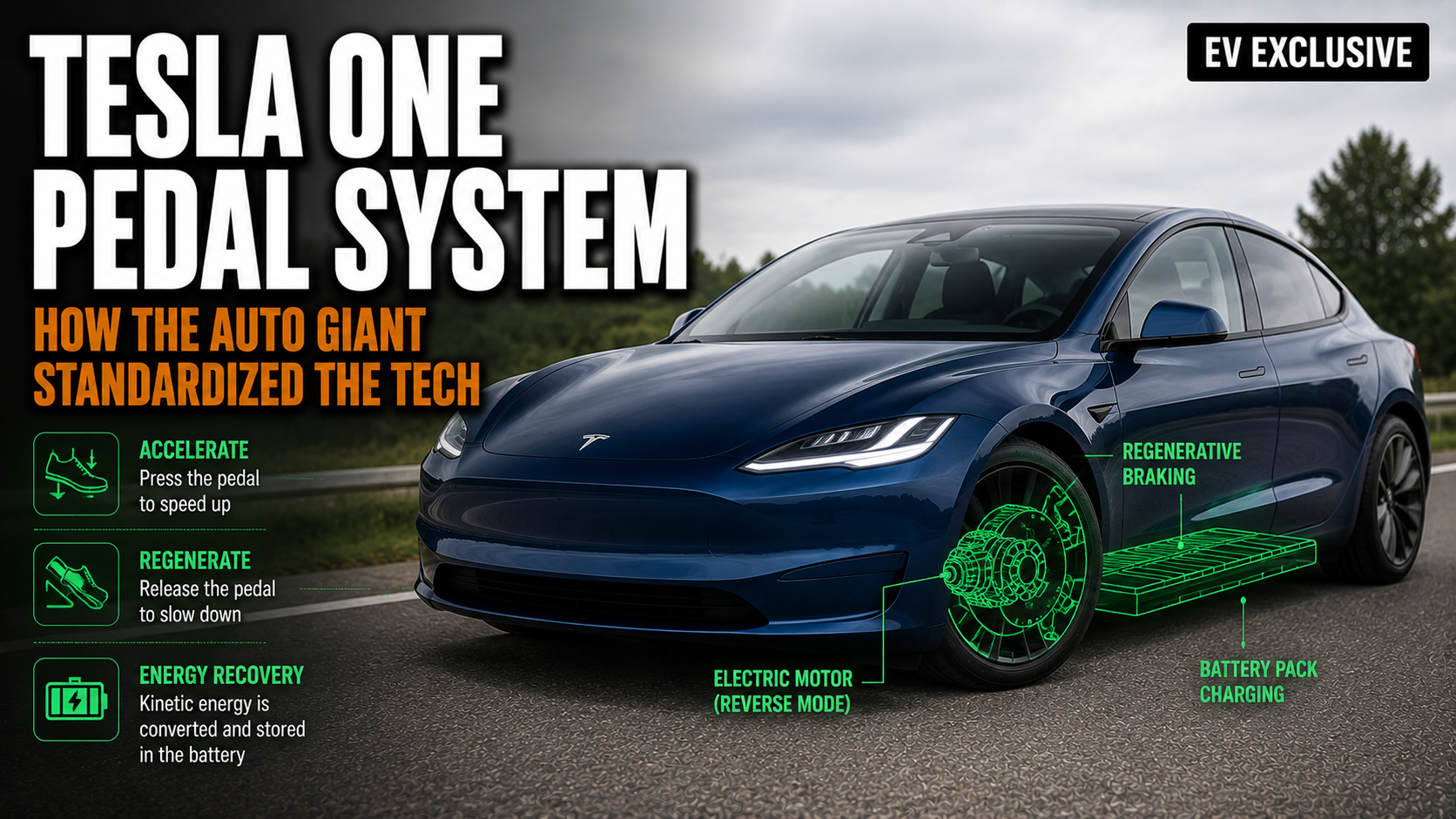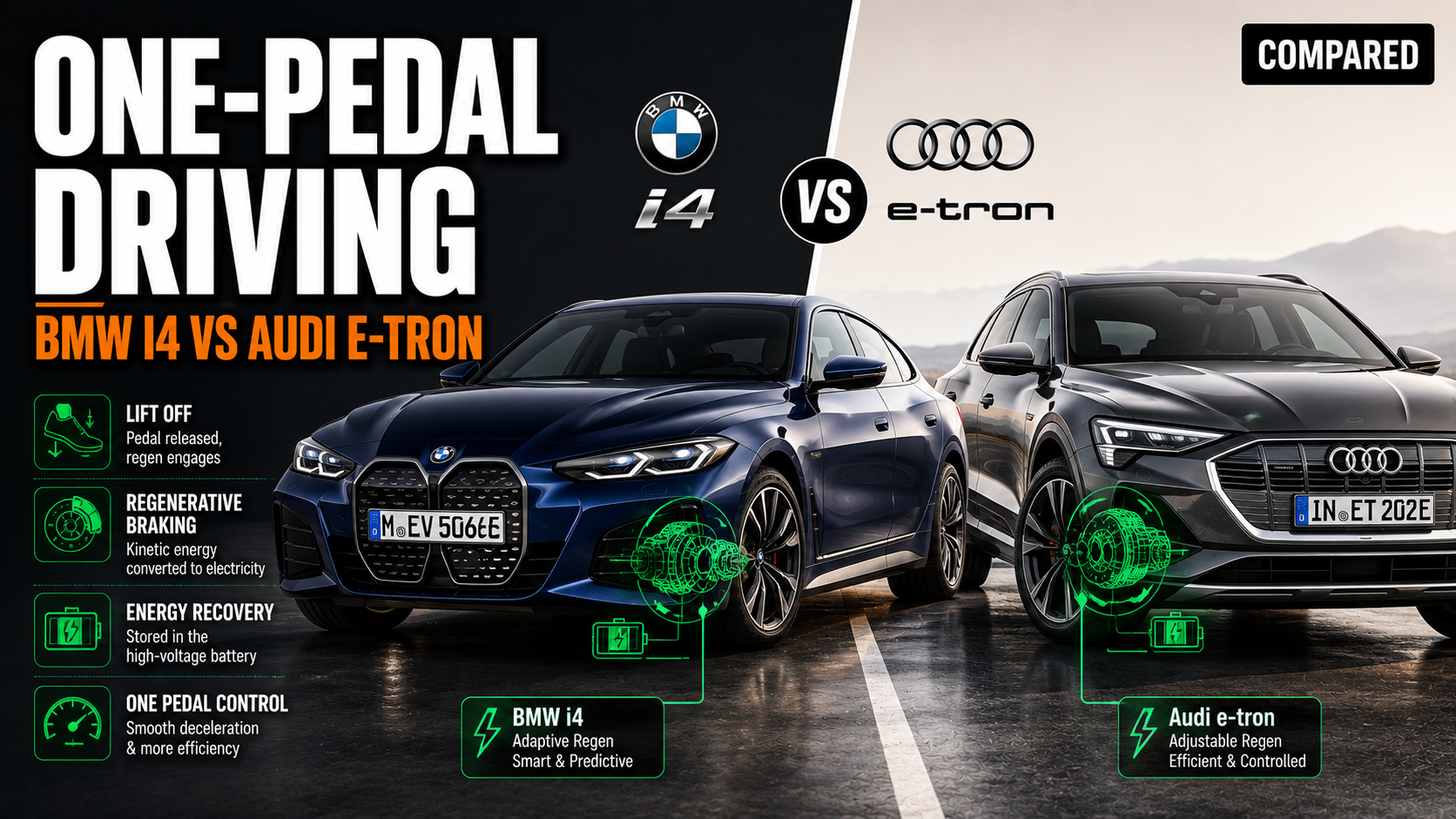

One-pedal driving on the BMW i4 is activated by shifting the drive selector into B mode, which applies strong regenerative braking the moment you lift your foot off the accelerator — slowing the car smoothly to a complete stop without ever touching the brake pedal. It is not on by default; the i4 starts in D mode every time.
That single detail frustrates almost every BMW EV owner who migrates from a Tesla. But once you understand why BMW built it this way — and how the regen system actually works at a physics level — the design starts to make more sense. This guide covers everything: how to enable one-pedal driving on the i4 and iX, how Audi’s e-tron takes a fundamentally different philosophy, and which approach recovers the most energy.
One-Pedal Driving Settings at a Glance
| Model | Mode for One-Pedal | Set as Default? | Max Regen | Stops Completely? |
|---|---|---|---|---|
| BMW i4 | B mode (shift lever twice from D) | No | ~up to 100 kW | Yes (with Auto Hold enabled) |
| BMW iX | B mode (shift lever twice from D) | No | ~up to 195 kW | Yes (with Auto Hold enabled) |
| Audi e-tron / Q8 e-tron (55/50) | Manual mode + paddles at max | No | 220 kW | Yes |
| Audi e-tron S | Manual mode + paddles at max | No | 275 kW | Yes |
| Audi Q4 e-tron | B mode or Manual + max paddle | No | ~up to 145 kW | B mode: creep speed only |
How BMW i4 One-Pedal Driving Works
The BMW i4 uses a blended braking system, which is the most important thing to understand before obsessing over regen settings. Here is what blended braking actually means in practice:
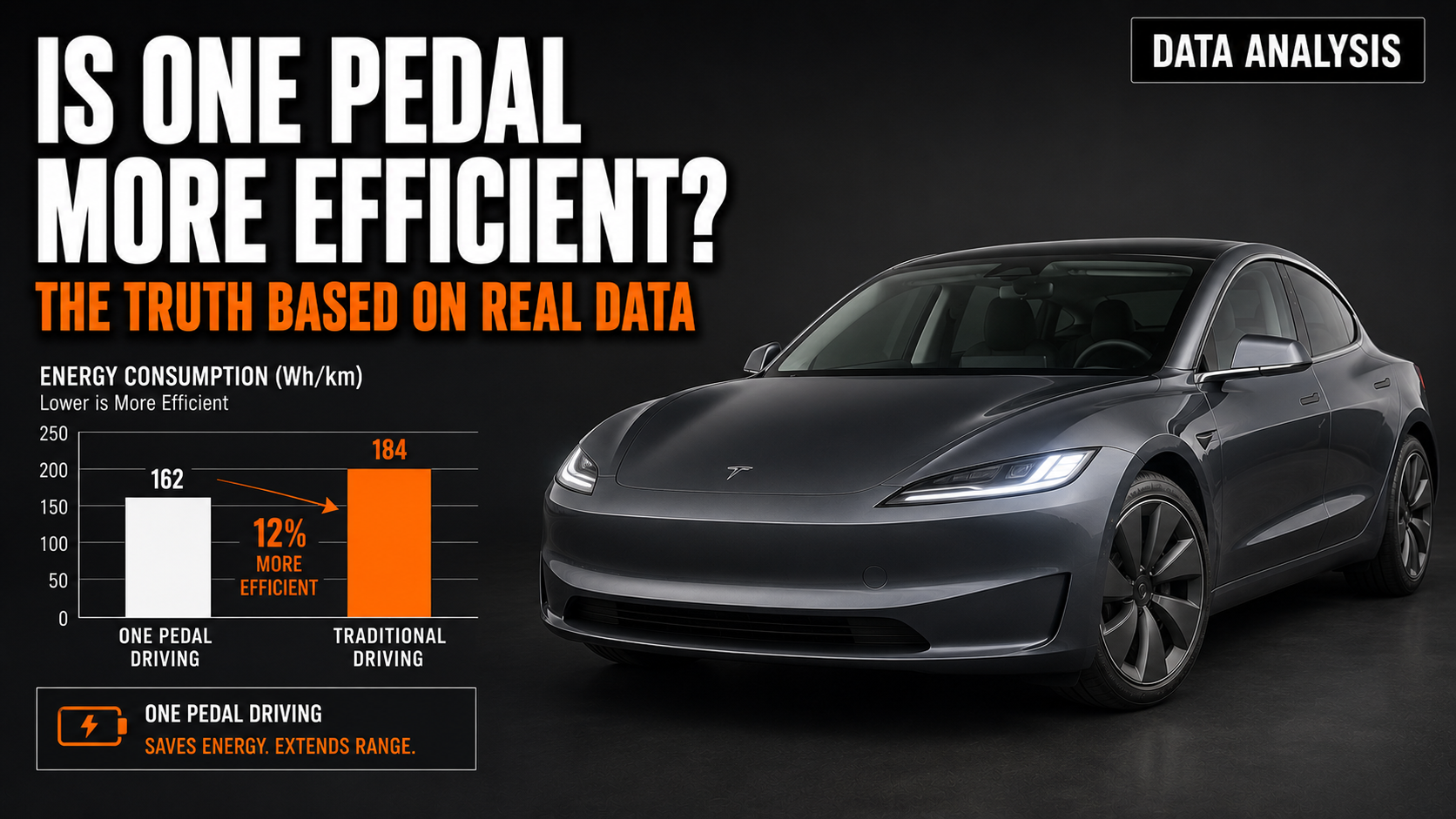
When you slow the i4 at the same rate — whether in B mode (lifting off the accelerator) or D mode (pressing the brake pedal gently) — the total energy recovered by the electric motor is nearly identical. The mode only changes which pedal triggers the energy recovery, not how much energy comes back. BMW confirmed this publicly, and it has been independently verified across owner communities on i4talk.com.
That said, B mode does change the driving experience in a meaningful way:
- B mode: Lifting your foot immediately engages strong regen. The car decelerates at roughly 0.2–0.3g, slowing to a stop in most traffic scenarios. With Auto Hold enabled in iDrive, the car holds stationary until you press the accelerator again — true one-pedal operation.
- D mode (Adaptive): Uses front sensors and GPS map data to detect upcoming junctions, roundabouts, and slower traffic, applying regen automatically when needed. BMW considers this the most energy-efficient setting because the car coasts when the road ahead is clear rather than harvesting energy that wasn’t needed.
- D mode (Low / Medium / High): Fixed regen levels applied when you lift off. High regen in D mode approaches — but reportedly does not fully match — the stopping power of B mode.
How to activate: Pull the shift lever down once to enter D. Pull it down a second time to enter B. That second pull is the one most owners forget.
The startup default problem: Every time you start the BMW i4 or iX, the car reverts to D mode. There is currently no native iDrive setting to make B mode the startup default on the current generation i4. Some owners reported an older i3-era knob allowed a mechanical B mode lock; the i4’s electronic shifter does not replicate this. Several owners on i4talk.com have requested a software update. BMW has not released one as of publication
BMW iX One-Pedal Driving: Same Logic, Bigger Battery
The BMW iX xDrive50 operates on the same B mode / D mode logic as the i4. The practical experience is nearly identical — shift down twice from the default D position, and the iX delivers strong regenerative deceleration the moment your foot lifts.
A few iX-specific details worth knowing:
Higher recuperation ceiling: The iX’s larger dual-motor setup pushes more power back into its 111.5 kWh battery than the i4 eDrive40’s single motor. This means the sensation of deceleration in B mode feels slightly more aggressive on the iX at highway speeds, where regen torque is highest.
D Adaptive on the iX: The Adaptive regen setting in D mode on the iX uses the front radar and camera suite together with HD map data to pre-emptively regen before corners, speed limit changes, and preceding vehicles. Owners report this works well but can feel inconsistent — occasionally braking for overhead gantries or map errors. You can override it immediately by pressing the accelerator.
The DAPP factor: Owners with the Driver Assistance Professional Package (DAPP) report that D Adaptive combined with DAPP essentially handles city stop-and-go autonomously. The combination of adaptive cruise and predictive regen means the car manages most braking situations before you react. This reduces the practical gap between B mode and D Adaptive for daily commuting.
Brake pad longevity: Because the iX — like the i4 — routes nearly all sub-0.3g braking through the electric motor rather than the friction brakes, brake pad wear is minimal. Multiple iX owners have reported 40,000+ miles with the original pads still serviceable.
Audi e-tron One-Pedal Driving: A Completely Different Philosophy
The original Audi e-tron (now rebadged Q8 e-tron) was deliberately designed to not require one-pedal driving. Audi’s position at launch was that coasting is more efficient than constant lift-off regen — a claim that has some validity in steady highway conditions but is debated for city driving.
Here is how the Audi system actually works:
Default (Automatic mode): The car coasts when you lift your foot. Regen only kicks in when the Predictive Efficiency Assist detects a reason to slow — an upcoming vehicle, a mapped speed zone, or a sharp corner. Pressing the brake pedal gently triggers regen up to 0.3g; pressing harder blends in friction brakes beyond that threshold.
Manual mode + paddles = one-pedal driving: To get true one-pedal behavior on the Audi e-tron, you must go into the MMI system (Vehicle → Efficiency Assistant → Recuperation → Manual), then set the steering wheel paddle to its maximum level each time you start the car. In Automatic mode, using the paddles is only temporary — the regen level resets to automatic the moment you touch the accelerator. In Manual mode with the paddle at maximum, lifting off the accelerator brings the car to a near-complete stop.
Electrohydraulic brake system: The Audi e-tron uses a world-first electrohydraulically integrated brake system. The control unit computes required braking torque in milliseconds; in emergency braking, full hydraulic pressure builds in approximately 150 milliseconds. The transition between electric and hydraulic braking is seamless at normal deceleration levels.
Recuperation capacity: The e-tron 55 and 50 variants recover up to 220 kW during braking. The e-tron S can reach 275 kW. Audi claims up to 30% of total range can come through recuperation in mixed driving. Below very low speeds, the system switches to friction brakes because the motor cannot generate meaningful regen torque at low rotational speeds.
Q4 e-tron note: The Q4 e-tron handles this differently — it offers a B mode selector on the shifter in addition to the paddle system, similar to BMW’s approach. However, some Q4 owners report B mode only decelerates to a creep speed rather than a full stop, which limits true one-pedal operation without also using the brake pedal.
BMW vs Audi: Which Regenerative System Is Actually More Efficient?
The honest answer is that neither produces clearly superior real-world range in all scenarios. Both systems recapture approximately the same energy for a given amount of speed change — the physics of kinetic energy recovery doesn’t favor one software implementation over another at equivalent deceleration rates.
| Scenario | BMW i4 / iX Winner | Audi e-tron Winner |
|---|---|---|
| City stop-and-go | B mode convenient; DAPP automates well | Manual mode viable, but requires setup each drive |
| Highway cruising | D Adaptive (coast when clear) | Automatic mode (coast first) |
| Mountain descents | B mode or D High holds speed well | Both motors recuperate; rear motor preferred by default |
| Brake pad preservation | Excellent — regen handles ~90% of braking | Excellent — electrohydraulic system prioritizes regen |
| Ease of one-pedal setup | Moderate (two lever taps per trip) | Moderate (MMI setting + paddle each trip) |
The real-world break-even for brake maintenance: at average US driving of 15,000 miles per year, most BMW i4 and e-tron owners on regen-heavy settings are seeing original friction pads last 5–7 years before replacement — compared to 2–3 years on typical ICE vehicles with similar annual mileage.
When One-Pedal Driving Is NOT Right for You
One-pedal driving is a poor fit in these specific situations:
- Highway cruising at steady speed: Constant micro-adjustments from regen create unnecessary energy cycles. D Adaptive (BMW) or Automatic (Audi) saves more energy by coasting.
- Following closely in traffic: If you have a tailgating habit, B mode can catch you off-guard — the car decelerates faster than a trailing ICE driver expects. The brake light does activate during regen, but some owners report a slight delay in the lamp response.
- Steep parking maneuvers: The BMW iX does not support B mode in Reverse. Precise slow-speed rearward movements require disabling Auto Hold and using the brake pedal directly.
- Drivers coming from an ICE vehicle: The learning curve is real. If you’ve driven petrol cars for 20 years, your instinct is to cover the brake, not trust the accelerator pedal to stop the car. Give yourself 2–3 weeks before judging.