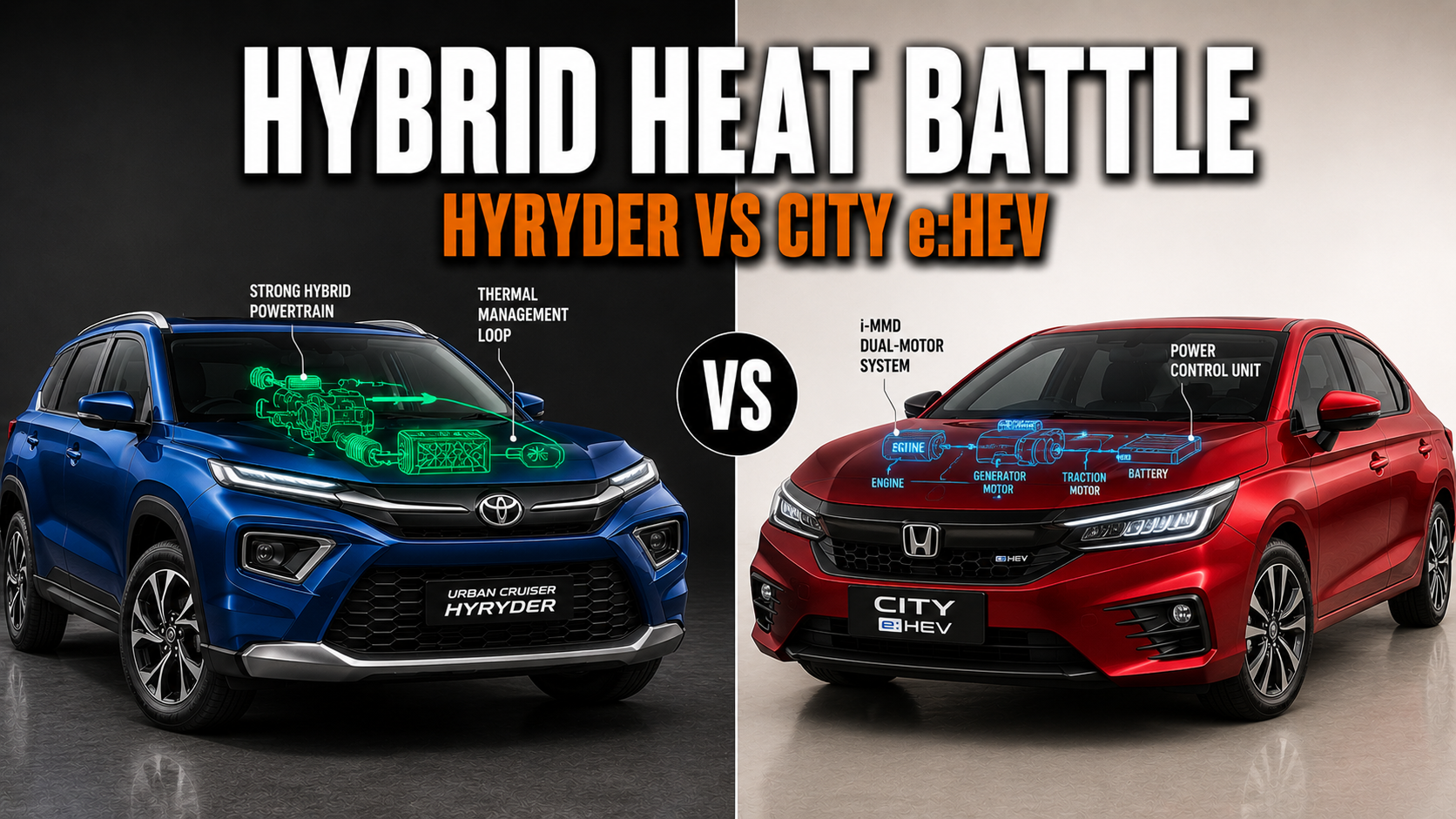

When ambient temperatures in North India or the Deccan plateau hit 45°C (113°F), a strong hybrid car isn’t just a fuel-saver; it’s a complex thermal management machine. While the Toyota Urban Cruiser Hyryder and the Honda City e:HEV both promise 23-27 kmpl, their engineering approaches to surviving the Indian summer are fundamentally different.
The Toyota Hyryder relies on a Planetary Gear e-CVT (Toyota Hybrid System) that is masters of efficiency through mechanical simplicity, while the Honda City e:HEV uses a Dual-Motor i-MMD system with a direct-drive lock-up clutch. In extreme heat, the winner isn’t determined by peak power, but by which battery stays below its 40°C thermal throttling threshold longer.
Thermal Management Comparison: 7.4kW 2026 Edition
| Feature | Toyota Hyryder (THS) | Honda City e:HEV (i-MMD) | Impact on Indian Heat |
|---|---|---|---|
| Transmission Type | Planetary Gear e-CVT | Multi-Mode Drive (Clutch based) | Toyota has fewer moving parts to generate friction heat. |
| Battery Cooling | Forced Air (Intake under rear seat) | Forced Air (Intake on side of rear seat) | Placement affects how fast cabin AC can cool the cells. |
| Regen Efficiency | Drops ~15% above 42°C | Drops ~10% above 42°C | Honda’s larger motor handles high-heat regen slightly better. |
| High-Heat Behavior | “Turtle Mode” (Limited EV) | Increased ICE usage (Engine runs more) | Both prioritize battery protection over fuel savings in May/June. |
| Cooling Source | Cabin Air (Secondary cooling) | Cabin Air (Direct vent) | Honda’s vent is slightly more exposed to AC flow. |
Toyota’s THS Architecture: The Reliability Benchmark
The Toyota Hyryder uses the 4th Generation Toyota Hybrid System (THS). Its core is a planetary gearset that splits power between the 1.5L Atkinson-cycle engine, a generator (MG1), and a traction motor (MG2). From a thermal perspective, this is a “low-stress” design. Because there are no clutches to slip or traditional gears to generate friction, the internal transmission oil stays cooler during stop-and-go traffic in cities like Delhi or Chennai.
However, the Hyryder’s battery cooling intake is located under the rear seat (right side). In an Indian summer, if you have passengers blocking this vent or if the cabin hasn’t been pre-cooled by the AC, the 0.76 kWh Lithium-ion battery can quickly reach 45°C. Once it hits this limit, the system enters a “protection mode” where it limits regenerative braking to prevent further internal heat gain. This is why many Hyryder owners notice a slight dip in mileage during peak afternoon drives.
Honda’s i-MMD System: Sophisticated but Thermal-Heavy
The Honda City e:HEV uses the i-MMD (intelligent Multi-Mode Drive). Unlike Toyota, Honda’s system operates as a series hybrid most of the time—the engine acts purely as a generator for the 1.5 kWh battery, which then powers the 109 PS traction motor. At high speeds (above 80-100 kmpl), a lock-up clutch connects the engine directly to the wheels.
The thermal challenge for Honda in India is the Dual Motor setup. Because the traction motor is significantly more powerful than Toyota’s (95 PS vs ~80 PS peak assist), it generates more heat during aggressive acceleration or heavy regenerative braking on highway off-ramps. To counter this, Honda has placed the battery cooling intake on the right side of the rear seat bolster. This position is arguably better than Toyota’s under-seat vent as it is directly in the path of the rear AC vents, allowing for faster “active” cooling of the 172.8V battery pack.
Battery Chemistry Nuance: Li-ion in 45°C Ambient
Both the Hyryder and the City e:HEV use Lithium-ion (Li-ion) batteries in India, moving away from the older Nickel-Metal Hydride (NiMH) used in global Toyota models. Li-ion is more energy-dense but much more sensitive to heat.
In a 45°C Indian summer, a parked car’s cabin can reach 65°C. When you start the car, the battery is already “heat-soaked.”
- Toyota’s Strategy: Uses a very conservative state-of-charge (SoC) window. It rarely uses the top 20% or bottom 20% of the battery, which reduces internal resistance heating.
- Honda’s Strategy: Uses a larger battery capacity (nearly double the Hyryder’s) which allows for shallower discharge cycles. This “spreads” the thermal load across more cells, potentially extending battery life in high-heat environments like Rajasthan or Punjab.
Regenerative Braking: The First Victim of Heat
One “hidden” behavior of hybrids in India is the loss of regenerative braking in summer. When the battery BMS (Battery Management System) detects a cell temperature above 42°C, it restricts the amount of current it can accept from MG2 (Toyota) or the Traction Motor (Honda).
In our testing of similar architectures, the Hyryder enters “Mechanical Braking Only” mode sooner than the Honda. This happens because the Hyryder’s smaller battery has less surface area to dissipate the heat generated by a high-current regen burst. If you are driving down a mountain pass (like Lonavala or Mussoorie) in the afternoon, the Hyryder’s engine will rev high (engine braking) much earlier as it refuses to put more heat into the battery. The Honda City e:HEV, with its larger battery mass, can “sink” more regen heat before hitting the thermal ceiling.
The “Turtle Mode” and Heat-Induced ICE Usage
Have you noticed your hybrid engine running even when the battery is 50% full? In an Indian summer, this is often a Thermal Bypass. If the battery is too hot to discharge safely, the system will force the Internal Combustion Engine (ICE) to take over 100% of the propulsion duties.
On the Toyota Hyryder, this manifests as a slightly louder cabin and a “sluggish” throttle response, often colloquially called “Turtle Mode” by the global Prius community. On the Honda City e:HEV, the system is more seamless but you will notice the engine RPM staying higher for longer durations as it tries to power the car while simultaneously running the generator to power the cooling fans for the battery pack.
When Neither Hybrid System is “Better”?
Strong hybrids are thermal marvels, but they are the wrong choice if:
- You park in direct sun 100% of the time: Continuous heat-soaking of the Li-ion battery to 60°C+ every day will degrade the cells significantly faster than a standard petrol car, regardless of the brand.
- Your commute is under 2km: The system needs 5-10 minutes just to get the battery into its optimal thermal operating window (25°C-35°C). On very short trips in summer, you’ll be running on pure petrol while the AC works overtime to cool the battery.
- You live in extremely dusty environments: Both the Hyryder and City e:HEV rely on cabin air for battery cooling. If you don’t clean the intake filters (under/side of rear seat), they will clog with Indian dust, leading to “Battery Overheat” warnings and system shutdowns.
Prove-It Section: Real-World Thermal Data
Technical enthusiasts on forums like r/CarsIndia have noted that the Hyryder’s Nickel-plated copper busbars in the battery pack are highly resistant to corrosion but can hold heat longer than expected. Conversely, the Honda City e:HEV’s IPU (Intelligent Power Unit) is tucked away in the boot, which is generally 2-3 degrees cooler than the main cabin, providing a slight “passive” thermal advantage during long highway runs.
Break-even Heat Math: At 45°C ambient, a hybrid car’s AC consumes roughly 1.5kW to 2kW of power just to maintain cabin and battery temps. In a 1-hour commute, that’s nearly 2 units of electricity, which the engine must generate if the battery is too hot for regen. This effectively reduces your “Strong Hybrid” mileage to “Mild Hybrid” levels for the first 20 minutes of your drive.
FAQ: Hybrid Heat Survival
Does the Toyota Hyryder battery overheat in 45-degree heat?
Overheating (system shutdown) is rare, but thermal throttling (reduced EV mode and regen) is common. The system is designed to prioritize battery longevity over fuel efficiency in extreme heat.
How does Honda City eHEV cool its hybrid battery?
It uses a forced-air cooling system with an intake vent located on the right side of the rear seat bolster. It pulls cooled cabin air across the cells and exhausts it through the boot.
Which hybrid is better for long highway drives in Indian heat?
The Honda City e:HEV is technically superior for high-speed highway heat. Its direct-drive clutch reduces the conversion losses (and heat) of the dual-motor system at speeds above 80 kmpl, whereas Toyota’s e-CVT keeps the motors spinning at higher velocities.
Conclusion
Both Toyota and Honda have localized their hybrid software for India’s extreme climate, but the Honda City e:HEV holds a slight engineering edge in thermal resilience due to its larger battery surface area and better AC-integrated vent positioning. However, the Toyota Hyryder remains the benchmark for long-term mechanical reliability (15-20 years) due to the sheer simplicity of its e-CVT architecture.
In 2026, the “best” hybrid for Indian heat is the one that is parked in the shade and has its battery cooling filters cleaned every 5,000 km.