
If you have a family of five or more, a 7-seater is not a luxury — it is the only practical choice on Indian highways. But picking the wrong one costs you money for years: wrong fuel type for your mileage, third row nobody can actually use, or a car that feels premium in the showroom and exhausting in Bengaluru traffic.
This guide cuts through the list-for-the-sake-of-it approach most car portals use. Every car here is evaluated on three things that actually matter to an Indian family: seating comfort across all three rows, total running cost at realistic annual mileage, and crash safety rating — not just spec sheets.
At a Glance: Best 7-Seater Cars by Budget
| Budget | Best Pick | Ex-Showroom (Delhi) | Best For | Main Tradeoff |
|---|---|---|---|---|
| Under ₹10L | Renault Triber | ₹6.50–9.50L | City families needing occasional 7-seat flexibility | Third row is children-only on long trips |
| ₹10–15L | Maruti Suzuki Ertiga | ₹8.80–13.00L | High-mileage families, CNG users | No diesel, third row tight for adults |
| ₹12–18L | Kia Carens Clavis | ₹11.00–17.50L | Feature-conscious buyers, young families | 3-star NCAP |
| ₹15–22L | Tata Safari | ₹16.50–27.00L | Safety-first families, highway users | Petrol only, third row access awkward |
| ₹18–26L | Toyota Innova Crysta | ₹18.85–25.53L | Diesel-heavy users (30K+ km/year), fleet, comfort | Manual only, no automatic available |
| ₹18–31L | Toyota Innova Hycross | ₹18.70–30.68L | City families wanting fuel efficiency + automatic | Petrol/hybrid only, no diesel option |
| ₹20–25L | Mahindra Scorpio N | ₹13.49–24.95L | Rough-road users, SUV feel with 7 seats | Third row fold-inward, not ideal for long highway use |
Which 7-Seater Car is Best for a Family in India?
The Toyota Innova Hycross (hybrid variant) is the best all-round 7-seater family car in India for 2026 — if your budget is ₹24L and above. It combines genuine third-row space, automatic transmission, strong hybrid fuel efficiency, and Toyota’s proven reliability record. For families running under ₹20L, the Maruti Suzuki Ertiga is the smartest buy: lowest maintenance cost in the segment, CNG option available, and the highest resale value among cars under ₹13L.
The “best” answer shifts entirely based on three variables: annual running (determines if diesel makes financial sense), road type (highway vs city decides suspension preference), and third-row usage (whether adults or only children sit there regularly). The sections below break this down.
Best 7-Seater Cars Under ₹12 Lakh
Renault Triber — ₹6.50 to ₹9.50 Lakh
The Renault Triber is the only purpose-built 7-seater under ₹8 lakh, and it earns that position through a clever modular cabin rather than a stuffed one. The third row folds completely flat and the second row slides forward to create a flat floor, giving it genuine versatility that the Maruti Eeco (which is more van than car) cannot match for a private family.
Real-world third-row verdict: adults up to 5’8″ can sit in the Triber’s third row for city distances — 30 to 45 minutes — without serious complaint. Beyond that, the legroom forces children or teenagers only. Highway trips with all seven adults are not comfortable.
The 1.0L naturally aspirated petrol makes 72 bhp, which means highway overtaking with a full load requires planning. The car does not feel strained around town. Fuel efficiency averages 16–18 kmpl in mixed driving. ARAI claims 19 kmpl. There is no diesel or CNG option.
Best for: Compact city families who need a true third row for occasional short-distance use and cannot stretch to ₹10L.
Skip it if: You regularly drive with seven adults on highways, or you need a diesel for monthly running above 2,500 km.
Maruti Suzuki Ertiga — ₹8.80 to ₹13.00 Lakh
The Ertiga has been India’s volume 7-seater for a reason. Maruti’s service network covers over 3,500 outlets nationally — no other 7-seater manufacturer comes close. Spare parts cost a fraction of Toyota or Kia equivalents, and the 1.5L petrol engine is among the most bulletproof units in this segment.
The CNG variant (S-CNG) is the real differentiator: at ₹9.5–11L, it delivers running costs that beat any diesel 7-seater in the segment at mileage below 25,000 km/year. CNG running cost in major Indian cities averages ₹1.8–2.5 per km, versus ₹5.5–7 per km for petrol at current fuel prices}. For a family covering 20,000 km/year, that is a saving of roughly ₹55,000–₹80,000 annually.
Third-row comfort is honest for short trips: two adults can sit there on city runs. Highway use beyond 90 minutes is a teenager-and-under situation.
Best for: High-mileage CNG users in metro cities, resale-conscious buyers, first-time 7-seater buyers wanting low servicing stress.
Skip it if: You need a diesel automatic, or your trips regularly have seven adults covering 400+ km in a day.
Best 7-Seater Cars Between ₹12 and ₹22 Lakh
Kia Carens and Kia Carens Clavis — ₹11.00 to ₹17.50 Lakh
The Kia Carens was the first truly feature-loaded 7-seater under ₹15L in India, and the Carens Clavis is a cleaner, better-resolved version of the same platform. Six airbags are standard across most variants — that alone separates it from the Ertiga segment. The diesel variants (1.5L CRDi) make 116 bhp and are genuinely strong on the highway, returning 18–20 kmpl on long runs.
The captain seat option in the mid-spec variants gives second-row passengers airline-style recline. Third-row legroom is comparable to the Ertiga — not exceptional, but acceptable for teenagers and lean adults. One genuine differentiator over the Ertiga is the panoramic sunroof option and the connected car features (OTA updates, remote features through the app).
Kia’s service network has expanded significantly but still sits well below Maruti’s coverage. In tier-2 and tier-3 cities, budget extra time for service appointments.
Best for: Young families who prioritise features, safety equipment, and diesel efficiency over rock-bottom running costs.
Skip it if: You are in a tier-2 or tier-3 city with limited Kia service access, or you primarily need the third row for adults on long drives.
Tata Safari — ₹16.50 to ₹27.00 Lakh
The Tata Safari carries the strongest safety argument in this price range. It scored a 5-star rating in Global NCAP crash testing — one of the few 7-seaters at this price point to achieve that. Six airbags are standard, and the structure is genuinely engineered for occupant protection, not just airbag count.
The 2.0L Kryotec diesel (167 bhp, 350 Nm) is strong. But the automatic is only available in the diesel variant above the ₹21L price point, which is a frustrating restriction for city buyers. Petrol-automatic buyers pay a premium for the less efficient powertrain.
Third-row access is the Safari’s weakest real-world point. The second-row tumbles forward but the resulting gap is tighter than the Innova Crysta or Hycross. Tall adults will find boarding awkward. Once inside, headroom is good — the tall roofline helps here.
Best for: Safety-conscious families prioritising crash protection over everything, highway-heavy usage, buyers willing to pay for 5-star NCAP peace of mind.
Skip it if: You regularly board elderly family members in the third row, or you run under 15,000 km/year and a ₹20L+ commitment for a petrol-only auto seems hard to justify.
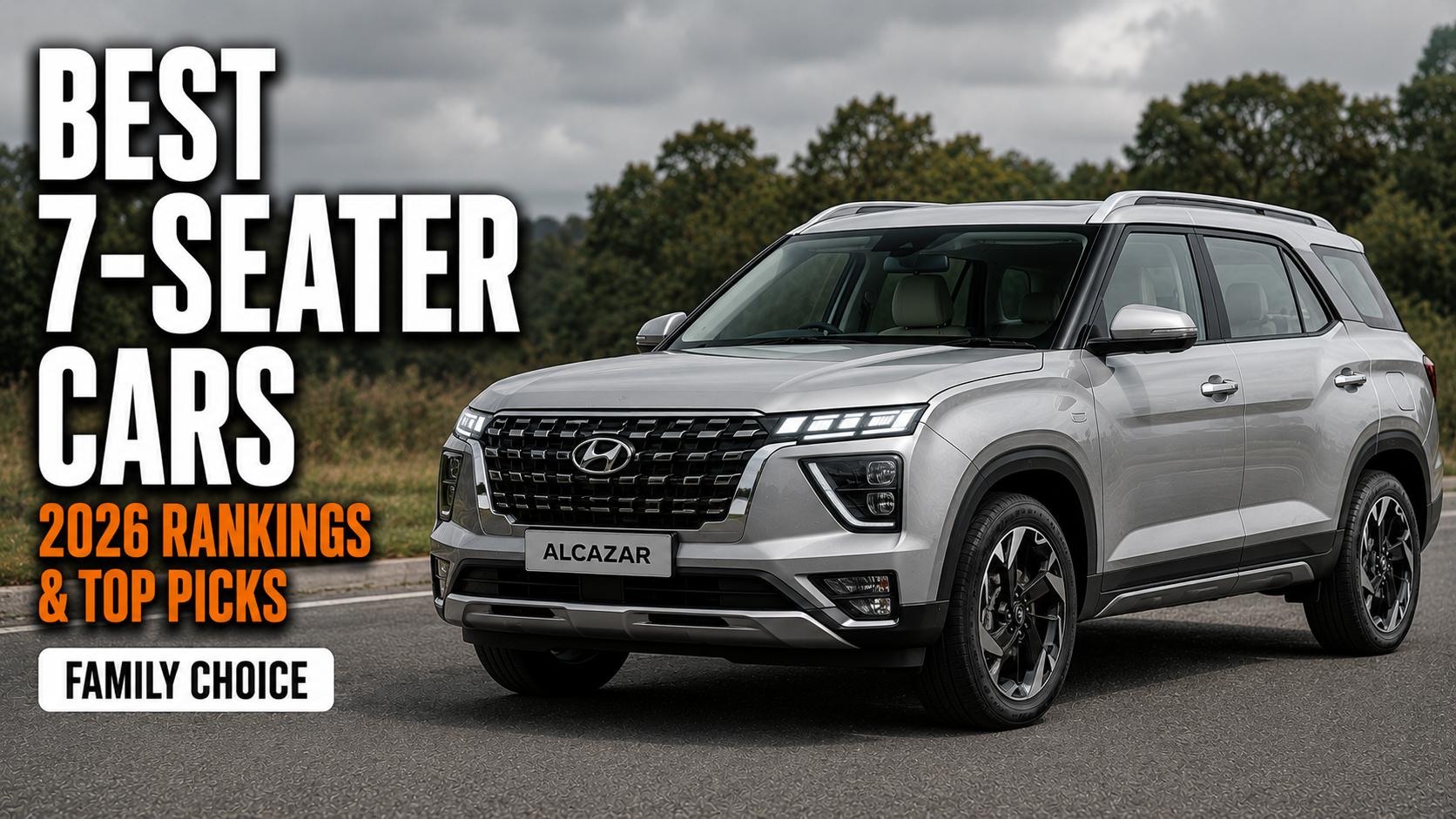
Hyundai Alcazar — ₹14.00 to ₹21.00 Lakh
The Hyundai Alcazar tends to get overlooked in the 7-seater conversation because it shares its platform with the five-seater Creta. That is also its advantage: the monocoque structure means noticeably better ride and handling balance compared to ladder-frame SUVs like the Scorpio. The diesel option (1.5L CRDi, 116 bhp) is smooth and efficient. An automatic is available across both petrol and diesel.
The Alcazar’s second-row captain seats are wide and comfortable — better bolstered than the Safari for highway cruising. Third row is similar to segment peers: two adult-sized passengers are fine, three is uncomfortable. The boot with the third row up is minimal (180 litres approximately).
Best for: Families who want SUV styling with MPV-grade ride quality, and prefer an automatic without going above ₹22L.
Best 7-Seater Cars Between ₹18 and ₹32 Lakh
Toyota Innova Crysta — ₹18.85 to ₹25.53 Lakh
The Innova Crysta is the de facto standard for Indian family travel, and it still earns that reputation in 2026. Toyota Kirloskar Motor has sold more than 12 lakh units across the Innova nameplate since launch — that density of ownership means the 2.4L diesel engine is one of the most independently documented units in India for long-term reliability. Diesel mechanics across the country know it by feel.
The 2.4L diesel produces 150 bhp and 343 Nm of torque — the torque figure is what matters on loaded highway runs. A Crysta with six adults and luggage pulls cleanly from 50 kmph in fourth gear. No other 7-seater in its price range does that with the same confidence.
What the Crysta does not offer anymore: an automatic gearbox. Toyota discontinued the automatic variant to reduce costs and reposition the Hycross as the AT choice. This is the single biggest reason to consider the Hycross instead.
Third-row usability is the Crysta’s strongest suit. The 4-link rear suspension keeps the body flat during cornering, which means the third-row seat is not on a constantly swaying platform. Three adults fit across the third row — the only 7-seater under ₹26L where this is genuinely true without serious protest.
TCO reality at 12,000 km/year: At 15.6 kmpl ARAI (real-world closer to 13–14 kmpl) and diesel at ₹92–95/litre, annual fuel cost is approximately ₹79,000–₹88,000. At 30,000 km/year, the diesel engine’s cost advantage over the Hycross petrol starts to justify itself. Below 20,000 km/year, the diesel premium in purchase price (₹2–3L more than the Hycross G non-hybrid) does not recover within a typical ownership cycle.
Best for: High-mileage families (25,000+ km/year), fleet and travel use, buyers who need to fit three adults in the third row reliably, anyone in a location with spotty CNG infrastructure.
Skip it if: You need an automatic gearbox, your annual running is under 18,000 km, or you drive primarily in congested city conditions where diesel efficiency gains disappear in traffic.
Toyota Innova Hycross — ₹18.70 to ₹30.68 Lakh
The Innova Hycross is the Crysta’s monocoque replacement — different architecture, different target buyer. It rides on a car platform (TNGA-C), not a ladder frame, which gives it a notably more car-like feel in corners and on patchy roads.
The strong hybrid variant (2.0L Atkinson cycle + motor, combined 183 bhp) returns 23.24 kmpl ARAI — the highest efficiency figure of any 7-seater in India. In real-world mixed city-highway driving, expect 18–20 kmpl. At ₹8/km running cost for the hybrid versus ₹6/km for the Crysta diesel at current fuel prices, the hybrid’s advantage is most pronounced in stop-and-go traffic where the electric motor takes over.
The Hycross is wider (1850mm vs 1830mm for the Crysta) and the wheelbase is 100mm longer. This translates directly to second-row legroom: the captain seats in VX and ZX variants recline to near-ottoman positions. Third-row legroom is adequate but slightly tighter than the Crysta due to the monocoque packaging.
Best for: City-heavy families wanting automatic transmission and maximum fuel efficiency. Buyers upgrading from an older Crysta who want a more modern, feature-loaded car.
Skip it if: You are a diesel loyalist with genuine high-mileage use (30,000+ km/year) where the Crysta’s diesel torque and lower purchase price make better financial sense.
Mahindra Scorpio N — ₹13.49 to ₹24.95 Lakh
The Scorpio N brought serious hardware to a segment that was overdue for an update. Its 2.2L mHawk diesel (130–175 bhp depending on variant) is mated to a 6-speed automatic — the only diesel automatic SUV 7-seater available below ₹22L. The suspension is tuned for rough roads: corrugated surfaces that unsettle monocoque vehicles are absorbed without drama here.
The 5-star Global NCAP rating makes the safety argument compelling. Six airbags and electronic stability control are standard on most variants.
The honest third-row caveat: Scorpio N seats fold inward on a jump-seat layout, not forward-facing stadium seating like the Innova. Three adults can fit but legroom is restricted and the third row is accessed by tilting the second row, which is inconvenient. For 400 km highway runs with adults in row three, this is not the ideal choice. For occasional weekend use or for carrying younger family members, it works fine.
Best for: Buyers who want diesel automatic in an SUV body below ₹22L, rough-road and semi-off-road usage, families where the third row is for children or occasional adult use.
Mahindra XUV 7XO — ₹12.49 to ₹22.00 Lakh
The XUV 7XO is Mahindra’s answer to the Tata Safari — a monocoque 7-seater with modern features and ADAS. The 2.0L turbocharged petrol and the 1.5L diesel options give buyers the choice the Safari does not. ADAS features including adaptive cruise control and lane-keep assist are available at a price point where they are genuinely rare.
Third-row access is better than the Scorpio N but not as effortless as the Innova. Legroom is tighter than the Safari’s tall roof would suggest.
Best for: Feature-first buyers who want ADAS in a 3-row SUV under ₹22L.
Which 7-Seater is the Safest in India?
| Car | Safety Rating | Test Body | Airbags (Standard) | Notes |
|---|---|---|---|---|
| Tata Safari | 5-Star | Global NCAP | 6 | Best structural protection in price range |
| Mahindra Scorpio N | 5-Star | Global NCAP | 6 | Strong body shell; SUV mass helps in frontal offset |
| Toyota Innova Crysta | 5-Star | ASEAN NCAP | 7 | Tested under ASEAN protocol; not Global NCAP |
| Toyota Innova Hycross | 5-Star | Bharat NCAP | 6–7 | |
| Hyundai Alcazar | Not yet tested | — | 6 | |
| Kia Carens | 3-Star | Global NCAP | 6 | |
| Maruti Ertiga | Not tested | — | 2–6 | |
| Renault Triber | 4-Star | Global NCAP | 2–4 |
For families where safety is the primary selection criterion, the Tata Safari and Mahindra Scorpio N are the two verified 5-star Global NCAP 7-seaters available under ₹25L. The Innova Crysta’s 5-star rating is from ASEAN NCAP — a credible test, but different protocol from Global NCAP.
Third-Row Reality Check: Can Adults Actually Sit There?
This is the question most car reviews bury in a paragraph at the end. Here is a straight answer for each car:
| Car | Third Row: Adult Usability | Entry/Exit | Highway Verdict (400 km+) |
|---|---|---|---|
| Toyota Innova Crysta | 3 adults, genuine comfort | Easy, dedicated tumble | Yes — best in class |
| Toyota Innova Hycross | 2 adults comfortably, 3 tight | Easy | Yes for 2, marginal for 3 |
| Tata Safari | 2 adults, entry awkward | Tight gap when second row tilts | Manageable for 2 |
| Mahindra Scorpio N | 2 adults, jump-seat style | Tilting second row, requires effort | Acceptable for short runs; not ideal 400 km+ |
| Kia Carens | 2 adults, shorter legroom | Easy | Manageable for lean adults |
| Maruti Ertiga | 2 lean adults, short trips | Easy | Not recommended for long runs |
| Renault Triber | Children / teens only | Easy, modular floor | No — children only |
The Innova Crysta is the only 7-seater in India under ₹26L where you can put three adults in the third row for a long drive without genuinely upsetting them. Every other car in this segment should be understood as a 5+2 configuration for highway trips.
Diesel vs Petrol vs Hybrid — What Makes Sense in 2026?
The diesel vs petrol decision is often settled with emotion (“I prefer diesel”) rather than numbers. Here is the break-even math at typical Indian ownership cycles.
Assume: Diesel purchase premium ₹2 lakh over equivalent petrol variant. Diesel ₹93/litre, Petrol ₹104/litre. Diesel mileage 16 kmpl real-world, Petrol 12 kmpl real-world.
At 10,000 km/year, the annual fuel saving with diesel is approximately ₹8,000–₹12,000. The ₹2 lakh premium takes 16–25 years to recover. Diesel makes no financial sense here.
At 25,000 km/year, the annual saving is ₹20,000–₹30,000. Break-even: 7–10 years. Borderline case.
At 35,000 km/year (commercial or very heavy use), the annual saving is ₹28,000–₹42,000. Break-even: 5–7 years. Diesel now makes clear financial sense.
The 2026 wrinkle with hybrids: The Innova Hycross strong hybrid at 20 kmpl real-world blurs the diesel advantage at all mileage levels. At 25,000 km/year, the hybrid costs roughly the same to run as the Crysta diesel while offering an automatic gearbox and city-traffic fuel recovery. The ₹3–5L hybrid premium is recoverable in 8–10 years at this usage — comparable to diesel.
Verdict: If you drive under 20,000 km/year, petrol or hybrid. Above 30,000 km/year and you need manual, diesel Crysta. Between 20,000–30,000 km/year, the Hycross hybrid is the most sensible all-round choice.
This Car is NOT For You If…
A 7-seater MPV or SUV is the wrong answer in these specific situations:
You drive under 8,000 km/year and use the third row once a month. The extra length (4.5m–4.8m) will be a daily parking and manoeuvring problem for a feature you barely use. A six-seater or a boot-extended hatchback rented for family trips makes more financial sense.
Your primary commute is in a congested city without a driver. A 4.7m vehicle in Bangalore or Mumbai traffic is mentally exhausting every day. Consider the length carefully before committing.
Your budget is under ₹10L and you expect genuine seven-adult highway comfort. There is no 7-seater in India under ₹10L that delivers comfortable third-row seating for adults on a 300 km highway trip. The Triber is the best available, and it is still a children-or-teenagers third row on long runs. Setting that expectation correctly before purchase prevents regret.
You expect diesel-like range from a hybrid. The Hycross hybrid’s 55-litre tank gives approximately 900–1,000 km per fill on the highway. The Crysta diesel’s 55-litre tank gives around 750–800 km at a harder driving pace. If range anxiety between fuel stops is a real concern for your driving pattern, verify the fuel station density on your typical routes.
FAQ: Best 7-Seater Family Cars in India
Which 7-seater car is best for a family in India?
For most Indian families, the Toyota Innova Hycross is the best overall 7-seater — it offers automatic transmission, strong hybrid efficiency, genuine third-row space, and Toyota’s reliability record. Families on a tighter budget (under ₹13L) will find the Maruti Suzuki Ertiga the smartest choice due to its low maintenance costs, CNG availability, and Maruti’s nationwide service reach.
Which 7-seater car is the safest in India?
The Tata Safari and Mahindra Scorpio N both carry verified 5-star Global NCAP ratings — the most rigorous test applied to Indian market cars. The Toyota Innova Crysta has a 5-star ASEAN NCAP rating (a credible but different protocol). For confirmed Global NCAP 5-star safety in a family 7-seater under ₹25L, the Safari and Scorpio N are the two choices.
Which is the best 7-seater car with a 5-star safety rating?
In India, 7-seaters with 5-star NCAP ratings include the Tata Safari (Global NCAP), Mahindra Scorpio N (Global NCAP), and Toyota Innova Crysta (ASEAN NCAP). The Innova Hycross has a 5-star Bharat NCAP rating. Among these, the Safari offers the best crash protection-to-price ratio for a private family buyer.
Which car is good for a family of 7?
For a family of exactly 7 members — meaning all three rows are regularly occupied — the Toyota Innova Crysta is the most practical choice. It is the only 7-seater under ₹26L where three adults can comfortably sit in the third row for highway journeys. The Innova Hycross is a close second. All other 7-seaters in this price range are effectively 5+2 vehicles for adult highway use.