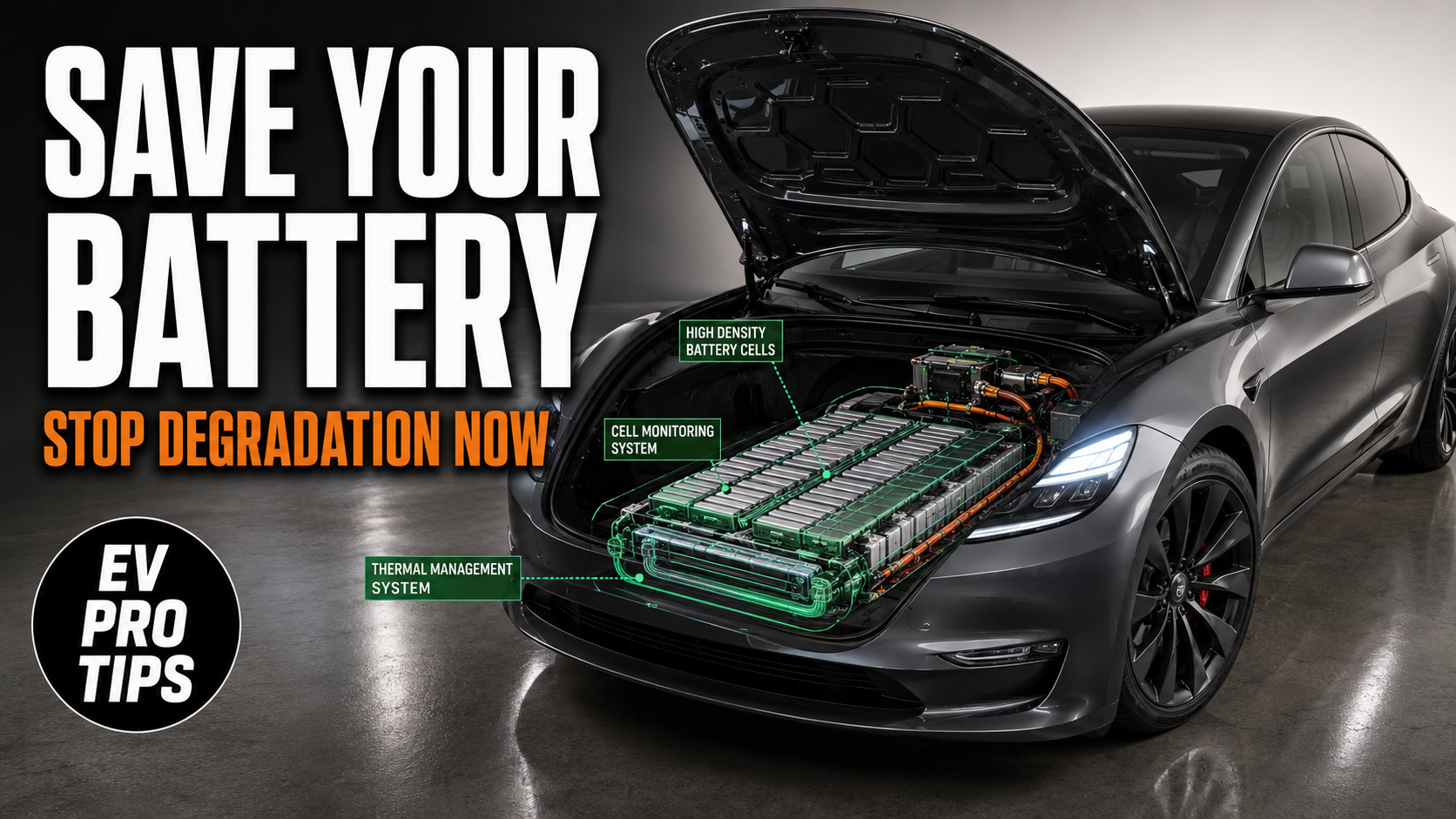

Battery degradation is the permanent loss of capacity and power delivery in a lithium-ion battery over time. In simple terms, it is the reason your EV, which once gave 300 km on a full charge, might only give 270 km after four years. While all batteries eventually lose health due to chemical aging, the speed of this decline is heavily influenced by how you charge, discharge, and store your vehicle—especially in a high-ambient-temperature environment like India.
Preventing degradation is not about stopping the clock, but about slowing it down. By mastering concepts like the 80/20 rule, minimizing Depth of Discharge (DoD), and managing thermal stress during the Indian summer, you can ensure your battery retains 90% or more of its original capacity even after 1,50,000 kilometers of driving.
The Battery Longevity Matrix
| Factor | High Degradation Risk | Optimal Health Practice | Differentiator |
|---|---|---|---|
| Charging Limit | Routinely charging to 100% | Keep between 20% and 80% | The 80/20 Rule |
| Storage Temp | Parking in direct sun (45°C+) | Basement or shaded parking | Active vs Passive Cooling |
| Usage Pattern | Running to 0% frequently | Frequent shallow top-ups | Depth of Discharge (DoD) |
| Fast Charging | Daily DC Fast Charging | Level 2 Home AC Charging | Thermal Management |
| Storage State | Storing at 100% or 0% | Store at 50% – 60% SOC | Calendar Aging |
The Science: Why Do EV Batteries Lose Capacity?
EV battery degradation happens through two primary paths: Cycle Aging and Calendar Aging. Understanding the difference is the first step toward prevention.
- Cycle Aging: This occurs when you use the battery. Every time ions move from the cathode to the anode and back, it causes microscopic stress. Over thousands of cycles, the internal structure of the electrodes begins to crack, and some lithium ions become “trapped,” no longer able to move. This is why high-mileage cars eventually see range loss.
- Calendar Aging: This is degradation that happens just by the passage of time, even if the car is parked. In India, calendar aging is accelerated by heat. High temperatures speed up the unwanted chemical side reactions inside the cell that thicken the “SEI layer” (Solid Electrolyte Interphase), making it harder for ions to pass through.
The Bottom Line: A car parked in 40°C heat in Rajasthan at 100% charge will degrade faster than a car being driven 100 km a day in a cooler climate.
Mastering Depth of Discharge (DoD): The “Simple” Secret
Depth of Discharge (DoD) refers to the percentage of the battery’s capacity that you use between charges. For example, if you drive from 100% down to 20%, your DoD is 80%.
The Science of Stress: Research shows that battery cycle life increases exponentially as you decrease the DoD. A battery might last for 1,000 cycles at 100% DoD (charging from 0 to 100), but the same battery could last for 5,000+ cycles if you only use 20% DoD (charging from 70 to 50, then back to 70).
The Practical Tip for India: Don’t wait for your battery to hit “Low” before plugging in. In our experience, frequent “shallow” charges are significantly healthier than “deep” cycles. If you have home charging, plug in every night to replace the 20-30% you used during the day. This keeps the battery in its chemical “comfort zone.”
The 80/20 vs. 30/90 Rules: Which One is Right?
You will often hear about “rules” to live by. Let’s break down the two most popular ones and why they matter for your daily routine.
The 80/20 Rule (The Gold Standard)
This rule suggests keeping your battery between 20% and 80% State of Charge (SOC). Lithium-ion batteries are most stable in this range. Above 80%, the high voltage puts “tension” on the chemical bonds. Below 20%, the low voltage can cause copper dissolution in some cell chemistries, leading to permanent damage.
The 30/90 Rule (The Practical Alternative)
Some owners find 80% too limiting for their daily commute. The 30/90 rule is a softer version. It still avoids the “stress zones” (100% and 0%) but gives you more usable range. While slightly less optimal than 80/20, it is infinitely better than charging to 100% every night.
Pro Tip: Most modern Indian EVs like the Tata Nexon EV or MG ZS EV have a “software buffer.” When your screen shows 100%, the physical battery might actually be at 95%. However, even with this buffer, the chemical stress is highest at the top. Save 100% charges only for the night before a long highway trip.
Thermal Management: The Indian Summer Factor
In India, heat is the #1 enemy of battery longevity. High ambient temperatures (35°C to 48°C) are well above the optimal 25°C operating temperature for lithium cells.
How to Prevent Heat-Induced Degradation:
- Active Cooling is King: When choosing an EV, prioritize those with Liquid Cooling (like the Tata Punch.ev or Hyundai IONIQ 5) over those with air cooling. Liquid cooling can pull heat away from the cells far more effectively during a fast charge.
- The “Shadow” Benefit: Parking in the shade is not just for your cabin comfort. A battery sitting in a car parked on black asphalt in 45°C heat can reach 60°C internal temperature. This “bakes” the chemistry and accelerates calendar aging. Always use basement parking or a covered porch if available.
- Cool Down Before Fast Charging: After a long highway run, the battery is already hot. If you immediately plug into a 50kW DC Fast Charger, the temperature will spike further. If possible, wait 10-15 minutes or drive slowly for the last 5 km to let the TMS bring the temperature down before hitting the DC plug.
DC Fast Charging: The “Junk Food” of EVs
DC Fast Charging (Level 3) is a marvel of convenience, but technically, it is “junk food” for your battery. It pumps a massive amount of energy (up to 350 kW) in a very short time, generating significant internal heat.
The Tradeoff: Frequent DC Fast Charging can cause the battery electrodes to expand and contract too rapidly, leading to mechanical fractures. Our Recommendation: Reserve DC Fast Charging for long trips. For daily use, stick to Level 2 (7.2 kW) AC charging at home or the office. The slower, more gentle flow of AC power allows the battery to stay cool and healthy. For a full comparison of home vs. public charging options, see our guide on the difference between Level 1, Level 2, and DC Fast charging.
Why Battery Obsession is “Not For You”
While protecting your battery is smart, excessive “range anxiety” or “health anxiety” can ruin the EV experience. If you find these protocols too restrictive, you might consider if a strong hybrid car fits your lifestyle better, as they require far less battery management.
Not For You If:
- You need 100% of your range daily: If your commute requires 100% of your battery every single day, the 80/20 rule is impractical. Charge to 100% and accept the slightly higher degradation—it’s still better than being stranded.
- You plan to sell the car in 3 years: If you change cars frequently, you may never see the effects of your habits. The next owner will, but you won’t. (Though a high State of Health – SOH report will help you get a better resale price).
- You use the car for high-speed commercial delivery: The revenue from more “uptime” often outweighs the cost of faster battery replacement in commercial fleets.
Frequently Asked Questions (FAQ)
What is the 80 20 rule for EV battery?
The 80/20 rule is a charging protocol where you keep the battery’s charge between 20% and 80%. This avoids the high-voltage stress found above 80% and the low-voltage risks below 20%, significantly extending the total cycle life of the lithium-ion cells.
Can an EV battery last 20 years?
While most manufacturers offer an 8-year warranty, a well-maintained EV battery can theoretically last 15-20 years. However, “last” usually means retaining at least 70% of its original capacity. After this point, the battery is still functional but may be better suited for “second-life” applications like home solar storage.
Does fast charging really damage the battery?
Occasional fast charging is fine. However, doing it daily can lead to faster degradation due to excessive heat and the mechanical stress of rapid ion movement. Modern Thermal Management Systems (TMS) mitigate this, but slow AC charging remains the healthier option for daily use.
Does the Indian climate kill EV batteries?
Extreme heat is a stressor, but Indian EVs are designed with this in mind. As long as you avoid parking in direct sunlight for long periods and utilize the car’s thermal management (by keeping it plugged in or using pre-conditioning), the battery will last its intended lifespan.
Conclusion: The Path to 2,00,000 Kilometers
Battery degradation is inevitable, but its speed is entirely in your hands. If you treat your EV like a mobile phone—plugging it in whenever possible to keep it in the 40-70% range, avoiding midday fast charging, and finding a patch of shade in May—you will likely find that the car’s chassis wears out before the battery does.
The “Golden Rule” is simple: Heat and Voltage are the enemies. Control them, and your battery will return the favor with years of reliable, cost-effective service on Indian roads. For more tips on winter-specific care, see our guide on how cold weather affects EV charging.