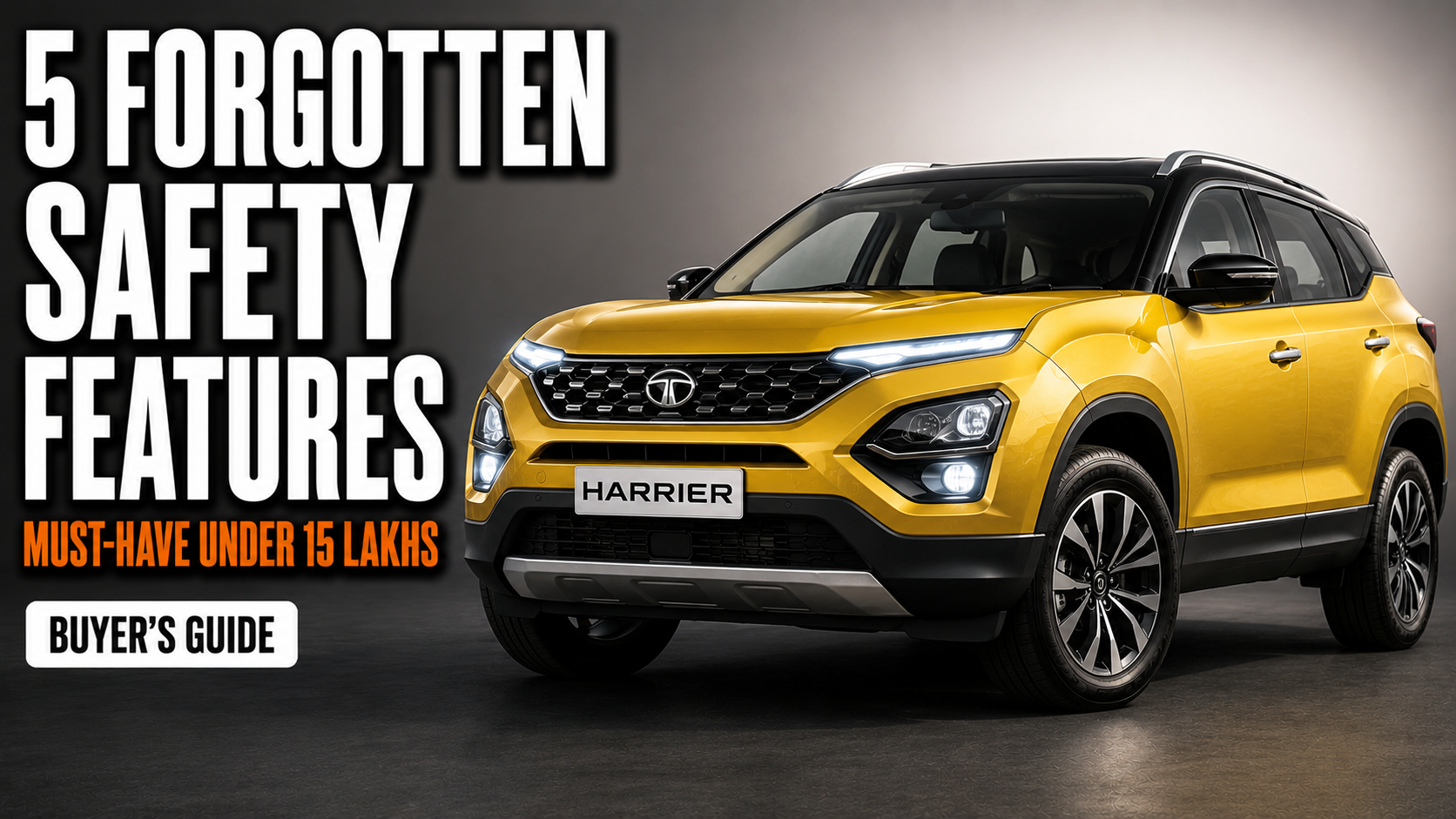

The safest car under 15 lakhs should protect every passenger, including the rear-middle adult and the child in the back seat. Before you pay for a sunroof, bigger screen, or leatherette pack, demand these 5 features: 3-point seatbelts for all seats, proper adjustable headrests, Electronic Stability Control, ISOFIX with top tether, and tyre-pressure monitoring with a real warning display.
Six airbags are useful. They are only one part of the safety chain. A rear passenger with a lap belt, a headrest stuck below neck height, or a car without ESC can still be badly exposed in a crash or highway avoidance manoeuvre.
| Forgotten feature | What to demand under 15 lakhs | Why it matters | Quick showroom test |
|---|---|---|---|
| 3-point seatbelts for all seats | Shoulder belt for the rear-middle passenger, not a lap-only belt | MoRTH reported 16,715 deaths linked to non-use of seat belts in 2022 | Sit in the rear-middle seat and pull the belt across your shoulder |
| Adjustable headrests | Rear headrests that rise high enough for adult occupants | Reduces head and neck movement in rear impacts and sudden stops | Raise each headrest and check if the top reaches ear level |
| ESC | Electronic Stability Control as standard, preferably on the base variant | ESC cuts loss-of-control crash risk, especially in SUVs and wet conditions | Check the brochure row for ESC/ESP/VSM across variants |
| ISOFIX and top tether | Rear outboard ISOFIX anchors plus top tether points | Child-seat fitment becomes repeatable and less dependent on belt routing | Find the anchor labels and ask the adviser to fit a child seat |
| TPMS | Highline TPMS, or at least a clear low-pressure warning | Underinflated tyres increase heat, braking distance, and highway failure risk | Look for per-tyre pressure display in the instrument cluster |
Why should car buyers under 15 lakhs look beyond 6 airbags?
Airbags protect after the crash has started. The forgotten features in this guide either prevent the crash, keep the body in the correct position, or make sure every passenger gets the benefit of the restraint system. That is the buying difference between a car that sounds safe in an advert and a car that behaves safely with five people on board.
India’s safety conversation has improved quickly. Bharat NCAP now publishes star ratings for Adult Occupant Protection, Child Occupant Protection, and Safety Assist Technologies, and its public homepage lists safety assist items such as Electronic Stability Control and seat-belt reminders as part of the wider star-rating conversation. Global NCAP’s updated India protocols also brought more attention to ESC, side impact, pedestrian protection, and rear seat-belt reminders after July 2022.
The issue for buyers is variant creep. A brand may advertise a safe car, then reserve a key feature for the second, third, or top trim. A buyer shopping at Rs 8 lakh to Rs 15 lakh ex-showroom must read the variant table and the headline together. Hyundai’s Exter page, for example, lists 6 airbags, ESC, seat-belt reminders for all seats, 3-point seatbelts for all seats, ISOFIX and adjustable rear headrests across the current feature table. Mahindra’s XUV 3XO launch note says the car comes standard with 6 airbags, ESC, 3-point seatbelts and reminders for all seats, and ISOFIX with top tether.
That is the standard to demand. If a car under 15 lakhs can give these features, another car in the same budget should not get a free pass for deleting them.
1. Why is a 3-point seatbelt for the rear-middle passenger so important?
A 3-point seatbelt restrains the pelvis and upper torso together. A lap-only rear-middle belt holds only the hips, which leaves the upper body free to fold forward in a crash. In a five-seat Indian family car, the middle rear passenger is often a parent, grandparent, older child, or office colleague. That person deserves the same basic restraint geometry as the window-seat passengers.
MoRTH’s Road Accidents in India 2022 report recorded 16,715 deaths and 42,303 injuries linked to non-use of seat belts in 2022; the same table separates drivers and passengers, with 8,331 passenger deaths recorded under non-wearing of seat belt. That number measures seat-belt use, while this guide focuses on seat-belt fitment and reminders. Together, the data and equipment gap show the size of the problem: Indian car occupants are dying in large numbers because restraint systems are absent, ignored, or defeated.
For years, many Indian cars gave the rear-middle occupant a lap belt. Union Minister Nitin Gadkari said in February 2022 that 3-point seatbelts would be mandatory for all front-facing passengers, including the rear-middle seat, according to PTI coverage of the announcement. Newer cars have started catching up. Tata Punch’s current official price page lists “3 Point ELR seats with seat belt reminder for all seats” on the Pure variant. Hyundai Exter’s table lists 3-point seatbelts and seat-belt reminders for all seats across its current variants.
Here is the showroom check: sit in the rear-middle seat. Pull the belt. If it comes only across your lap, reject the variant for regular five-person use. If the belt comes from the roof or seatback and crosses the shoulder, check whether it retracts smoothly and whether the buckle is easy to access. A belt buried under the cushion will be skipped by passengers.
The second check is the reminder system. A reminder for “all seats” is better than a driver-only buzzer because rear passengers in India often treat seat belts as optional. A full reminder display also prevents the common trick where someone buckles an empty belt behind the passenger to silence the alarm. Ask the sales adviser what the cluster shows when a rear belt is opened after the car starts moving.
2. Why do adjustable rear headrests matter in affordable cars?
An adjustable headrest is a restraint device, not a comfort accessory. It supports the head during rear impacts, sudden braking, and violent rebound after a frontal crash. In many budget cars, the rear seat gets fixed, low, or tiny headrests that look neat in photos and sit too low for adult neck protection.
The useful test is simple. Sit in the rear seat and raise the headrest fully. The top should reach roughly the top of your ears or the top of your head zone. If the headrest ends at the base of the skull for an average adult, it will not control head movement well. If the rear-middle seat has no headrest at all, that position should be treated as occasional seating for short city trips, not a proper highway seat.
This matters more in India than many spec sheets admit. Families under 15 lakhs often buy compact SUVs, premium hatchbacks, and compact sedans as “one car for everything.” The same car may do a 12 km school run, a 300 km highway trip, and a five-adult airport drop. A fixed rear headrest may pass casual inspection when the seat is empty. It becomes a real weakness when a 5 ft 10 in adult sits there on the expressway.
Some newer cars show how this should be handled. Hyundai’s current Exter feature table lists adjustable rear headrests across variants in the interior section. Mahindra’s XUV 3XO launch annexure lists adjustable headrests for the second row from the MX1 equipment list. Those details are easy to miss because brochures place them far below touchscreen, wheels, and upholstery.
Demand 3 checks during a test drive. First, sit all regular family members in the back and adjust the headrests. Second, confirm the headrest locks at each height and does not slide down with a light push. Third, fold and unfold the rear seat to see whether the headrests need removal. If the headrests are always removed to create boot space, they may never be reinstalled for passengers.
The rear-middle headrest deserves special attention. A car can have 3-point belts for all seats and still give the centre passenger a poor head restraint. If your family regularly travels five-up, the rear-middle passenger should get both: a shoulder belt and a usable headrest.
3. Why is ESC the safety feature you should demand before a sunroof?
Electronic Stability Control, also called ESC, ESP, VSM or stability control by different brands, helps the car correct a skid by braking individual wheels and reducing engine torque. It is most useful when the driver swerves to avoid a bike, hits standing water, enters a corner too fast, or makes a sudden steering correction on a broken highway.
The evidence for ESC is strong. A PubMed-indexed review of real-world studies found that ESC reduced fatal single-vehicle crashes by about 30% to 50% in cars and 50% to 70% in SUVs, with fatal rollover crashes estimated about 70% to 90% lower across vehicle types. NHTSA’s final rulemaking material for ESC also cited estimated reductions of 34% for single-vehicle passenger-car crashes and 59% for single-vehicle SUV crashes, with larger reductions for single-vehicle rollovers.
Those are international figures, but the driving situations are familiar in India. Wet monsoon roads, sudden cattle crossings, unmarked diversions, sand near construction zones, and fast lane changes on expressways all create loss-of-control risk. ESC cannot cancel bad driving. It can buy a driver a small correction window when the tyres still have grip left.
Under 15 lakhs, the good news is that ESC is no longer limited to luxury cars. Hyundai Exter lists ESC as standard across its current feature table. Tata Punch’s current official page lists Electronic Stability Program on the Pure variant. Mahindra says the XUV 3XO has ESC with Hill Hold Control as part of its 35 standard safety features. Tata Nexon’s official brochure lists Electronic Stability Program as standard, with 3-point ELR belts for all seats.
The buying rule is blunt: if you are choosing between a lower variant with ESC and a flashier rival without ESC, pick the car with ESC. The feature matters even more for taller vehicles because a compact SUV has a higher centre of gravity than a hatchback. It also matters for new drivers, tired highway drivers, and anyone who regularly drives in rain.
At the showroom, search the brochure for ESC, ESP, VSM, traction control, hill hold, and rollover mitigation. Then ask whether ESC is standard on the exact variant you are buying. A salesperson may say the model has ESC while pointing to a top trim. Your booking form should name the variant, engine, transmission, and safety pack clearly.
4. Why should ISOFIX and top tether be mandatory for family buyers?
ISOFIX anchors let a compatible child seat attach directly to fixed points in the rear seat. A top tether adds another restraint point to reduce forward rotation. For parents, the advantage is repeatability: the child seat clicks into the same place each time, instead of relying on a hurried seat-belt route before school.
India still has a weak child-seat culture. Many children sit on an adult’s lap, stand between the front seats, or use adult belts too early. A child who is too small for an adult belt can submarine under the lap belt or have the shoulder belt cut across the neck. ISOFIX does not solve behaviour by itself, but it removes one major excuse: “the seat is too difficult to install.”
Bharat NCAP separates Child Occupant Protection from Adult Occupant Protection, which is useful for buyers because a strong adult score does not automatically mean perfect child-seat usability. Global NCAP’s India protocols also include child occupant assessment and have pushed manufacturers to improve child-restraint fitment details.
Under 15 lakhs, ISOFIX availability has improved. Hyundai Exter lists child seat anchors across variants. Mahindra says the XUV 3XO has ISOFIX child seats with top tether as standard. Tata Punch’s official price page lists ISOFIX on the Pure variant feature list. Tata Nexon’s brochure also lists ISOFIX among the safety features, with the usual note that some features depend on variant or equipment pack.
The inspection takes 2 minutes. Look for ISOFIX labels between the rear seatback and cushion. Put your fingers into the gap and feel for the metal loops. Then open the boot and check for top tether anchor points behind the seatback, on the parcel shelf, or near the boot floor, depending on the car. If the adviser cannot find them, ask for the owner’s manual.
Parents should do one extra step: carry the actual child seat to the showroom or test-drive car. Some rear seats have anchor points but poor cushion angle, awkward buckle placement, or limited front-seat travel once the child seat is installed. A rear-facing seat can force the front passenger seat too far forward in compact cars. That is a packaging issue you want to find before delivery day.
5. Why does TPMS matter more than buyers think?
Tyre Pressure Monitoring System, or TPMS, warns the driver when tyre pressure drops. Highline TPMS shows individual tyre pressure values. A basic low-pressure warning is less detailed, but still better than finding a puncture after the sidewall has overheated on a highway.
Tyres are the only contact patch between the car and road. Underinflation increases heat, hurts braking, reduces fuel economy, and can damage the tyre internally. Overinflation reduces grip and makes the ride skittish on broken roads. In a loaded car doing a summer highway run from Delhi to Jaipur, Mumbai to Pune, Bengaluru to Mysuru, or Chennai to Coimbatore, a tyre problem can develop quickly.
TPMS is also a good honesty test for the car’s variant strategy. Brands often use the same safety headline across the model, then move TPMS to higher variants. Hyundai Exter lists Highline TPMS from selected variants in its feature table, while the safety page lists TPMS as part of the model’s safety equipmen. Tata Nexon’s brochure lists Tyre Pressure Monitoring System among the safety features, with feature availability depending on variant.
The feature has a practical maintenance benefit. A slow puncture often gives small clues: one tyre loses 3 to 5 PSI over a few days, or pressure rises unevenly after a highway run. Highline TPMS lets you spot that pattern before the tyre looks visibly low. This is especially helpful for cars with low-profile tyres, where a pressure drop is harder to see.
Ask 3 questions before booking. Does the variant show individual tyre pressure values or only a warning lamp? Does it monitor the spare wheel? What is the recommended cold tyre pressure for normal load and full load? The third answer should be in the door jamb sticker or owner’s manual. If the salesperson guesses, check the sticker yourself.
TPMS should not replace monthly pressure checks. Treat it as an early-warning system. Buy a decent pressure gauge, check the tyres when cold, and set pressure according to the car’s load. Safety features work best when the basic maintenance is done.
Which cars under 15 lakhs already get many of these features?
The safest shortlist changes with variant updates, discounts, and city-level on-road pricing. As of May 2026, these models are worth checking because their official pages or manufacturer releases mention several of the 5 forgotten safety features. Use this as a starting list, then verify the exact variant before booking.
| Model to inspect | Features worth checking | Main tradeoff | Best buyer fit |
|---|---|---|---|
| Hyundai Exter | 6 airbags, ESC, all-seat 3-point belts, all-seat reminders, ISOFIX, adjustable rear headrests | Compact cabin; rear width is tight for 3 adults | City families who still want a strong basic safety kit |
| Tata Punch | ESP, 3-point ELR belts with reminders for all seats, ISOFIX on current official listing | Rear seat width and engine refinement may not suit everyone | Small-family buyer prioritising ground clearance and safety basics |
| Tata Nexon | 6 airbags, Electronic Stability Program, ISOFIX, 3-point ELR for all seats in current brochure | Top variants can cross 15 lakhs ex-showroom depending on engine and gearbox | Highway users who want a compact SUV with strong safety equipment |
| Mahindra XUV 3XO | 6 airbags, ESC, 4 disc brakes, 3-point belts and reminders for all seats, ISOFIX with top tether | Feature-rich variants can stretch the budget | Drivers who want ESC, braking hardware, and family safety in one package |
| Hyundai i20 / Venue / Creta lower variants | Check for 6 airbags, ESC/VSM, 3-point belts, ISOFIX and TPMS by variant | Some safety and ADAS features are variant-linked | Buyers who want a polished cabin and can read the variant table carefully |
Do not treat this table as a final buying verdict. Treat it as a shopping filter. A car that passes the 5-feature test still needs a stable structure, good braking, predictable handling, clear headlights, and tyres suited to your use. A 5-star NCAP rating is useful, but even a 5-star car can be a poor family fit if the variant deletes rear safety hardware.
How to Inspect these safety features during a Test Drive?
The test drive should include a 10-minute safety inspection before the car moves. Sales advisers expect questions about mileage, colours, EMI and delivery period. Fewer buyers ask to sit in the rear-middle seat, inspect ISOFIX loops, or confirm ESC on the base variant. That is exactly why these checks work.
Start with the rear seat. Sit left, centre, and right. Buckle every belt. Confirm 3-point belts for all seats, check buckle access, and see whether the rear-middle belt blocks the split-folding function. Raise all headrests and check adult height. Then fold the seat down and back up to see whether the headrests stay installed.
Move to the instrument cluster. Turn the ignition on and watch the warning lamps. You should see seat-belt reminders, airbag warning, ABS, and ESC/traction-control tell-tales during the startup check. Warning lamps should turn off after the system check. A lamp that stays on in a demo car needs explanation.
Open the rear doors and inspect ISOFIX labels. Ask the adviser to show the top tether. If you already own a child seat, fit it. Check whether the front passenger still has knee room, whether the rear door closes easily, and whether the child seat blocks the seat-belt buckle for the adjacent passenger.
Check tyres last. Read the tyre size and load rating on the sidewall. Open the driver-side door and note the recommended cold pressure. If the car has highline TPMS, ask the adviser to show the pressure screen. If it has a warning-only system, ask how the warning resets after inflation.
Before you leave, photograph the variant sheet. The picture should show the model, variant, engine, gearbox, and safety rows. If the booking happens later, compare that sheet with the proforma invoice. Cars change with model-year updates, dealer stock, and special editions.
When these features still do not make a car safe enough?
This guide is a poor fit if you want a car mainly for high-speed highway driving with 5 adults and luggage and your budget forces you into a tiny hatchback. A 3-point belt and ESC improve the safety floor, but size, crash structure, tyre quality, braking performance, and stability at load still matter.
It is also a poor fit if you plan to defeat the safety systems. Seat-belt alarm clips, oversized aftermarket wheels, cheap tyres, bull bars, dark headlamp films, fake TPMS sensors, and poorly installed seat covers can reduce the value of factory safety equipment. A seat cover that blocks side-airbag deployment is a safety downgrade, even if the upholstery looks premium.
Skip cars where the feature list is unclear and the dealer cannot prove the exact equipment on the exact variant. “Sir, it comes in top model” is not good enough when your family will sit in the base or mid variant. Also be careful with older unsold stock. A newer brochure may list all-seat reminders or ESC, while an older manufactured unit in the yard may have a different equipment pack.
The harsh line: a car used regularly with rear passengers should not be bought purely for resale value, mileage, or screen size if the rear-middle restraint is weak. If your family travels five-up, the fifth passenger is not bonus cargo. That person needs a belt, headrest, and reminder system that work.
FAQ
Are 6 airbags enough for a safe car under 15 lakhs?
No. Six airbags are a strong feature, but they do not replace seatbelts, headrests, ESC, ISOFIX, tyre condition, and a stable vehicle structure. Airbags need occupants to be seated and belted correctly. A rear passenger without a proper 3-point belt may not be positioned correctly when airbags deploy.
Is ESC necessary in a small hatchback or compact SUV?
Yes, especially if the car will be used on highways, in rain, or by new drivers. ESC helps correct loss of control by braking individual wheels and reducing engine torque. The benefit is well documented in international crash research, with larger gains seen in SUVs and rollover-related crashes.
Should I reject a car if the rear-middle seat has only a lap belt?
Reject it for regular five-person use. A lap-only belt gives weaker upper-body restraint than a 3-point belt. If the car will mostly carry 4 people, you can treat the centre rear position as occasional, but families that regularly seat 5 people should demand a proper 3-point rear-middle belt and headrest.
Is ISOFIX useful if I can install a child seat with the seatbelt?
Yes. Seatbelt installation can be safe when done correctly, but ISOFIX makes correct installation easier and more repeatable. Parents who move child seats between cars or remove them for luggage will benefit from the simpler click-in mounting.
Which safety feature should I prioritise if my budget allows only a lower variant?
Prioritise ESC, 3-point seatbelts for all seats, and usable rear headrests before cosmetic upgrades. If you have children, add ISOFIX and top tether to that must-have list. TPMS is highly recommended for highway users, especially in hot weather and fully loaded trips.