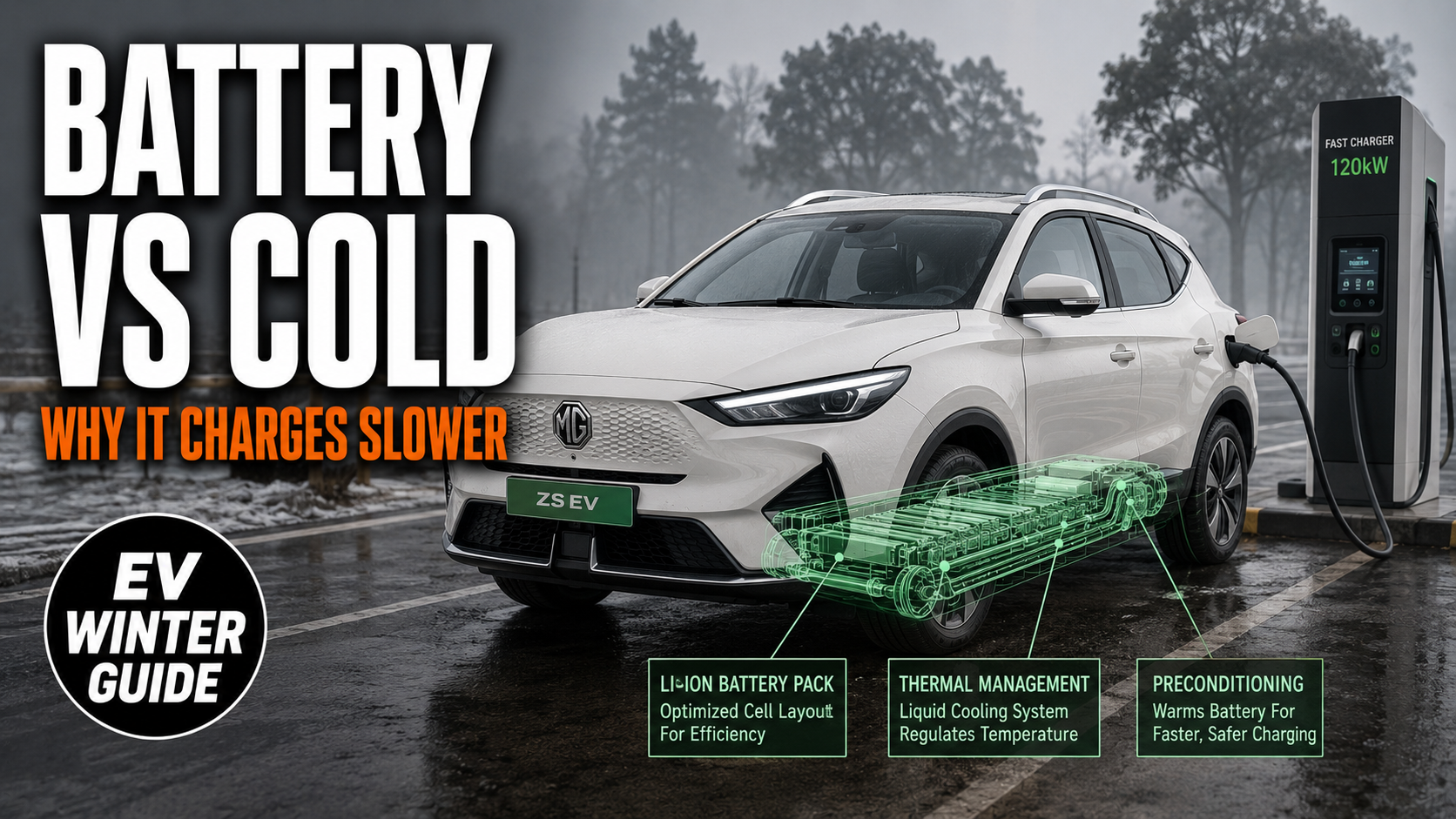

The primary reason cold weather affects EV battery charging times is that low temperatures increase the internal resistance of lithium-ion cells, slowing down the chemical reactions required to store energy. In North India—ranging from the chilly winters of Delhi and Punjab to the sub-zero extremes of Himachal and Ladakh—this can mean your charging session takes 30% to 50% longer than it does in the summer.
While modern EVs like the Tata Nexon EV or MG ZS EV have Thermal Management Systems (TMS) to heat the battery, this heating process itself consumes electricity. In regions like Spiti or Leh, where temperatures can drop to -20°C, the car may spend the first 30 minutes of a “charging session” simply warming the battery before a single unit of energy is actually stored.
Winter Charging Reality in North India
| Temperature Range | Charging Speed Impact | Est. Range Loss | Critical Precaution |
|---|---|---|---|
| 10°C to 20°C (Delhi/Punjab) | 10% – 15% Slower | 5% – 8% | Charge immediately after driving. |
| 0°C to 10°C (Shimla/Manali) | 25% – 30% Slower | 12% – 20% | Use a Level 2 wallbox, avoid Level 1. |
| Below 0°C (Ladakh/Spiti) | 50%+ Slower | 30% – 40% | Pre-condition battery while plugged in. |
The Science: Why Cold Batteries Are “Stubborn”
To understand the delay, you have to look inside the cell. Lithium-ion batteries work by moving ions through a liquid electrolyte. When it gets cold, this liquid becomes more viscous (thicker). Imagine trying to swim through honey versus water—that is what the lithium ions face in a North Indian winter.
Furthermore, if you attempt to “Fast Charge” a frozen battery without pre-heating, you risk Lithium Plating. This is where lithium ions coat the surface of the anode instead of entering it, which can cause permanent battery degradation or even internal shorts. This is why your car’s software will “throttle” or limit the intake of energy to a fraction of its maximum capacity (e.g., a 50 kW DC charger may only deliver 12 kW) until the battery reaches an optimal 20°C to 30°C.
Level 1 vs. Level 2 Charging in North Indian Winters
In India, most EV owners rely on the standard 15A socket (Level 1) or a 7.2 kW Wallbox (Level 2). In winter, the choice between these two becomes critical. For a detailed breakdown of these standards, see our guide on the difference between Level 1 and Level 2 charging.
The “Phantom” Charge Loss: A Level 1 charger delivers roughly 2.5 kW to 3.0 kW. In a Delhi January morning (5°C), your EV’s thermal management system might use 1.5 kW to 2.0 kW just to keep the battery from freezing. This leaves only ~1 kW for actual charging. A session that normally takes 12 hours could easily stretch to 24 hours.
The Level 2 Advantage: A 7.2 kW Level 2 wallbox provides enough “overhead” to power the heater AND charge the battery at a reasonable rate. If you live in North India, relying solely on a 15A socket in winter is a “nightmare scenario” waiting to happen.
DC Fast Charging on North Indian Highways
If you are driving from Delhi to Chandigarh or Shimla in winter, your highway charging strategy must change.
- The “Warm Battery” Rule: Never pull up to a DC fast charger first thing in the morning after the car has been sitting in the cold. Drive for at least 30-40 minutes to let the natural heat of discharge warm the cells.
- Fog Impacts: North Indian winters are synonymous with heavy fog. Fog increases humidity, which can lead to moisture buildup on charging pins. Always check your CCS2 connector for condensation before plugging in at a highway station like those on the KMP Expressway or NH44.
- Bharat DC-001 Limitations: Older 15 kW Bharat DC chargers found in government offices often lack sophisticated communication with the vehicle’s BMS. In sub-zero temperatures, these chargers may fail to initiate a handshake with your vehicle if the battery voltage has dipped due to extreme cold.
Cost Implications: Why Winter Charging is More Expensive
While the cost per unit (kWh) in Delhi stays around ₹7 to ₹9, your cost per kilometer increases in winter.
- Efficiency Drop: In summer, a Nexon EV might give you 7.5 km/kWh. In a cold North Indian winter, with the heater running and battery heating active, this drops to 5.5 km/kWh.
- INR Math:
- Summer: ₹1.06 per km (at ₹8/unit)
- Winter: ₹1.45 per km (at ₹8/unit)
- The Verdict: You are paying ~36% more to drive the same distance, primarily because energy is being diverted from the wheels to the heater.
Himalayan Special: Charging in Ladakh and Spiti
Charging an EV at 11,000+ feet in -15°C is a technical feat. For those taking a family EV for a Himalayan trip, remember the “High Altitude Cold Start”:
At these temperatures, the electrolyte can practically gel. If you park your car overnight without plugging it in, the battery might enter a “Protection Mode.” You may find the car “on” but unable to move or accept a charge. The Fix: Always leave the car plugged into a 15A socket (even if it’s not “charging”) to allow the car to draw power from the grid to run its internal heaters. This is the only way to ensure the car is ready to drive at sunrise.
Why Winter EV Life is “Not For You” (In Specific Scenarios)
Despite the tech, EV charging in North Indian winters isn’t for everyone.
Not For You If:
- You have no dedicated parking: If you park on the street in Delhi or Chandigarh, you cannot “Pre-condition” the car while plugged in. You will start every morning with a cold battery, losing 20% of your range immediately to heating.
- Your daily commute is under 10km: The energy spent heating the cabin and battery for a 10-minute drive is massive relative to the distance. You will see “astronomical” consumption figures (like 300 Wh/km) that will make the car feel inefficient.
- You rely on public charging only: Waiting 90 minutes at a fast charger in a foggy Punjab highway because your battery was too cold to accept 50 kW is a miserable experience.
Frequently Asked Questions (FAQ
Can it be too cold to charge an EV in India?
Yes, in regions like Ladakh or Lahaul-Spiti, temperatures can drop below -20°C. Most EVs will refuse to charge if the internal battery temperature is below -30°C to prevent permanent damage. You must warm the battery using the car’s internal heaters first.
How cold is too cold for an EV battery?
While EVs work fine down to -10°C, you will notice a significant drop in charging speed and range once temperatures dip below 5°C (typical for peak Delhi winters). Below 0°C, a Level 2 charger becomes mandatory for practical daily use.
Should I plug in my EV every night in winter?
Absolutely. In North Indian winters, keeping the car plugged in allows the Battery Management System (BMS) to draw power from the grid to maintain the battery’s temperature. This ensures you have full power and maximum charging speed when you start your day.
Is life with an electric car in winter really a nightmare?
Not if you have a home charger. The “nightmare” stories usually come from owners who rely on public fast charging and don’t understand that a cold battery cannot accept high power. With a home wallbox, you simply wake up to a warm, full car every day.
Conclusion: Mastering the North Indian Winter
The difference between a “winter nightmare” and a seamless EV experience in North India is Infrastructure and Intent. If you live in the plains (NCR, Punjab), a simple upgrade to a 7.2 kW Level 2 wallbox solves 90% of charging delays. If you are venturing into the Himalayas, the “Always Plugged In” rule is your literal lifeline.
Charging takes longer in the cold—there is no way around the physics. But by understanding the “Honey vs Water” electrolyte transition and pre-conditioning your vehicle, you can ensure that your EV remains a reliable, cost-effective tool even when the mercury disappears.


《How Cold Weather Affects EV Battery Charging Times in North India》有1条评论