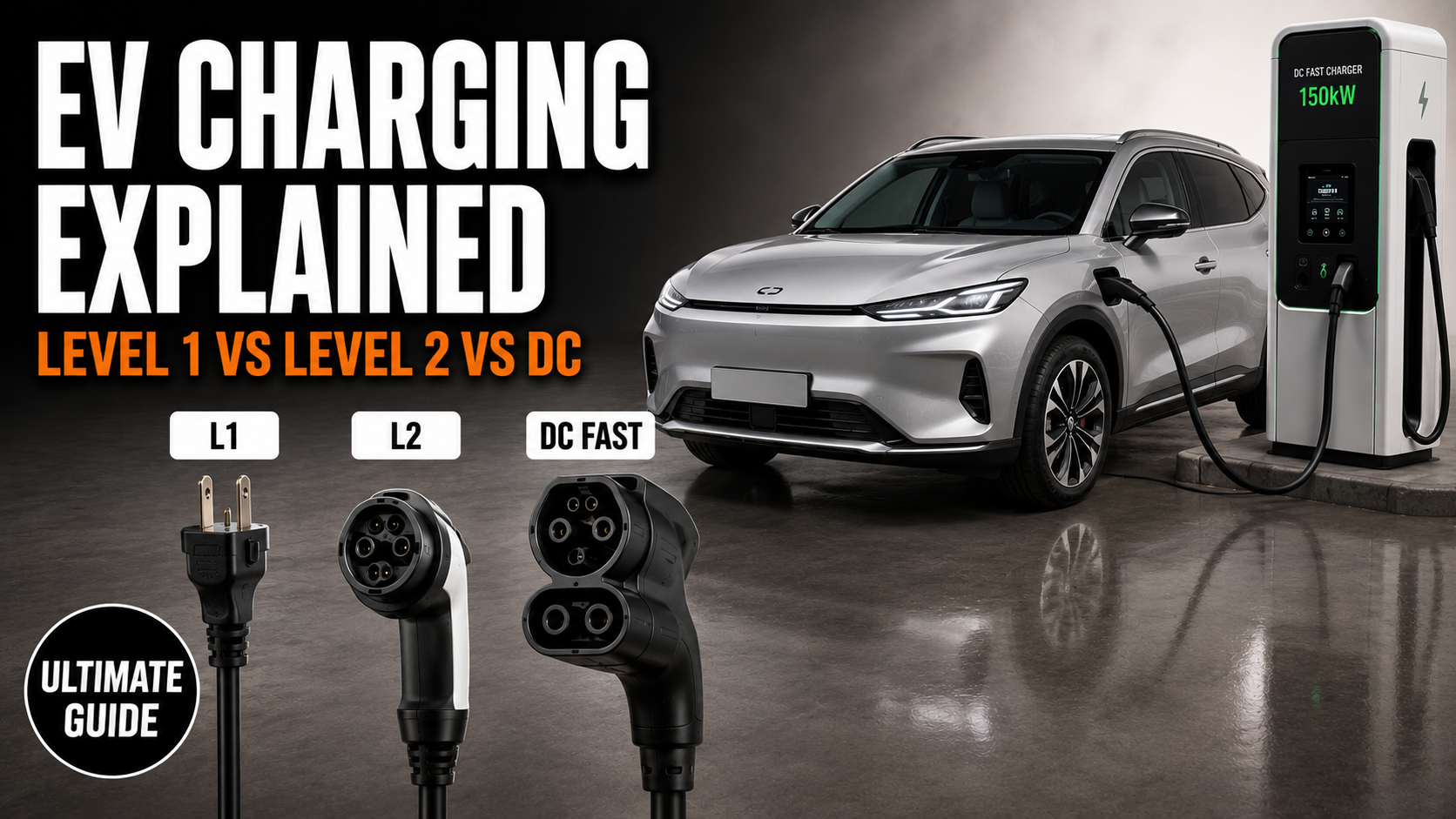

The primary difference between Level 1, Level 2, and DC Fast Charging (Level 3) lies in the voltage, charging speed, and the hardware required to convert electricity into a form your EV’s battery can store. In India, where the grid operates at a nominal 230V, Level 1 uses a standard home socket, Level 2 requires a dedicated wallbox or AC station, and DC Fast Charging bypasses the car’s onboard charger to deliver high-power energy directly to the battery pack.
While global guides often focus on US-centric 110V systems (which are inherently slower), the Indian landscape is unique. We have higher base voltage, the prevalence of Bharat AC-001 and DC-001 standards for smaller vehicles, and the near-universal adoption of CCS2 connectors for four-wheelers. Understanding these levels is the difference between charging your Tata Nexon EV in 60 minutes or waiting 17 hours for a full top-up.
EV Charging Levels at a Glance
| Feature | Level 1 (Slow AC) | Level 2 (Fast AC) | DC Fast Charging (Level 3) |
|---|---|---|---|
| Typical Voltage | 230V (Single Phase) | 230V – 415V (1 or 3 Phase) | 400V – 800V+ (DC) |
| Power Output | 2.5 kW – 3.3 kW | 7.2 kW – 22 kW | 25 kW – 350 kW+ |
| Connector Type | Standard 15A Socket | Type 2 (Mennekes) | CCS2 / GB/T / CHAdeMO |
| Charge Time (0-80%) | 12 – 18 Hours | 4 – 8 Hours | 30 – 60 Minutes |
| Est. Cost per Unit | ₹6 – ₹10 (Domestic) | ₹8 – ₹15 (Public) | ₹18 – ₹28 (Public) |
| Best For | Overnight home charging | Office or Home wallbox | Highway travel / Quick top-ups |
The Technical Core: AC vs DC Charging
Before diving into the levels, you must understand the “conversion bottleneck.” All EV batteries store energy as Direct Current (DC). However, the electricity coming from your home socket or a public AC station is Alternating Current (AC).
In Level 1 and Level 2 charging, your car acts as the middleman. It uses an Onboard Charger (OBC) to convert that AC power into DC. The speed of Level 1 and 2 is physically limited by the capacity of this OBC. If your car has a 7.2 kW OBC, plugging into a 22 kW AC station won’t make it charge any faster.
In DC Fast Charging, the conversion happens outside the car in the massive charging cabinet. It bypasses the OBC entirely and pumps DC energy straight into the battery. This is why DC charging is exponentially faster—it removes the car’s internal bottleneck.
What is Level 1 EV Charging? (The “Trickle” Method)
Level 1 charging is the most basic form of EV replenishment, utilizing the standard 15A “big” power outlet found in almost every Indian kitchen or garage. Every electric car sold in India, from the entry-level MG Comet to the luxury Audi e-tron, comes bundled with a portable Level 1 charger.
Technical Specifications
- Voltage: 230V Single Phase
- Amperage: Usually limited to 10A or 12A to protect home wiring.
- Power Output: 2.3 kW to 3.3 kW.
Technically, Level 1 is Single-Phase AC charging. Because home sockets are capped to prevent circuit overloads, the power output is low. In reality, due to voltage fluctuations and heat loss (which can be up to 15% in India’s climate), you often see a steady 2.5 kW delivery.
Who is this for? Level 1 is ideal for “trickle” charging. If you drive less than 40-50 km per day, plugging in overnight for 8 hours will recover that range. However, for a full 0-100% charge on a 40.5 kWh battery (like the Nexon EV LR), expect a wait time of nearly 18 hours.
Level 2 Charging Explained: The Home & Office Standard
Level 2 charging is the “sweet spot” for 95% of Indian EV owners. It operates on a higher amperage and can utilize a 3-phase connection (415V). In India, most residential apartments offer 7.2 kW single-phase wallboxes as the standard installation.
The Jump to 3-Phase Charging
While a 7.2 kW charger is standard, many high-end EVs and public AC stations use 11 kW or 22 kW outputs. This requires a 3-phase electrical connection.
- 7.2 kW: 230V x 32A (Single Phase)
- 11 kW: 230V x 16A x 3 Phases
- 22 kW: 230V x 32A x 3 Phases
In India, the Type 2 (Mennekes) connector is the mandated standard for Level 2. Unlike Level 1, which uses a standard plug, Level 2 requires a dedicated circular 7-pin connector. This connector features “communication pins” that allow the car and the charger to negotiate the safest maximum current before the juice starts flowing.
Pro Tip: If you are buying a second-hand EV like an older Mahindra eVerito, check if it has a Type 2 inlet. Some older Indian EVs used the GB/T standard even for AC charging, which can make finding public AC chargers difficult.
DC Fast Charging (Level 3): The Highway King
DC Fast Charging (DCFC) is the only viable option for inter-city travel. These chargers are essentially giant power plants in a box, ranging from 25 kW (common in city malls) to 350 kW “Superchargers.”
The CCS2 Standard in India
India has officially adopted the CCS2 (Combined Charging System 2) as the standard for passenger cars. This plug has the circular Type 2 top for AC charging and two massive DC pins at the bottom.
- Tata & MG: Use CCS2 for all their modern 4W EVs.
- Hyundai & Kia: Support ultra-fast 800V charging (up to 240 kW on compatible chargers).
- Tesla (Upcoming): Expected to use CCS2 for the Indian market, similar to their European models.
The “80% Rule”: You will notice that DC fast chargers slow down significantly once your battery hits 80%. This is a safety measure to prevent “lithium plating”—a phenomenon where lithium ions build up on the anode faster than they can be absorbed, potentially causing a fire or permanent capacity loss. The last 20% can often take as long as the first 80%.
The “Hidden” Indian Standard: Bharat AC-001 and DC-001
While global discussions focus on Level 1, 2, and 3, India has its own unique infrastructure category: the Bharat Standards. These were developed by the Department of Heavy Industry (DHI) to jumpstart the ecosystem for small vehicles.
- Bharat AC-001: A 10 kW system providing three 3.3 kW sockets. It’s designed for 2-wheelers and 3-wheelers. It uses the IEC 60309 industrial plug, not the standard home plug.
- Bharat DC-001: A low-voltage DC system (72V – 100V) providing 15 kW. This was the “fast charger” for the first generation of Indian EVs (e2o Plus, eVerito). It uses the GB/T connector.
The Reality Check: For a modern EV owner, Bharat chargers are mostly irrelevant. New public installations are 99% CCS2. If you see a charger labeled “Bharat DC-001,” your Nexon or MG ZS EV likely won’t even be able to plug into it.
EV Charging Cost Analysis in India (INR Breakdown)
Charging costs in India are not universal. They are governed by State Electricity Regulatory Commissions (SERCs).
| Charging Type | Est. Cost per Unit (kWh) | Monthly Cost (1000 km) |
|---|---|---|
| Home (Domestic) | ₹6 – ₹10 | ₹900 – ₹1,500 |
| Public AC (Level 2) | ₹12 – ₹18 | ₹1,800 – ₹2,700 |
| Public DC (Level 3) | ₹20 – ₹28 | ₹3,000 – ₹4,200 |
State-Specific EV Tariffs in India
The cost per unit (kWh) is not just about home vs. public; it depends heavily on your pin code. Many Indian states have introduced “EV-specific” domestic tariffs to encourage adoption.
- Maharashtra: Offers a flat ₹7.25 per unit for EV charging across domestic and public stations, one of the most transparent in India.
- Delhi: The Delhi EV Policy 2020 (recently extended) offers a cap of ₹4.50 per unit for low-tension (LT) EV charging. However, with “Fixed Charges” and “Power Purchase Adjustment Charges” (PPAC), the effective rate is often ₹7-₹8.
- Karnataka: BESCOM recently revised its EV charging tariff to roughly ₹5.00 per unit for the first few units, aiming to make Bangalore the EV capital of India.
Before you install a Level 2 charger, contact your local DISCOM (BSES, Tata Power, MSEDCL) to request a separate EV meter. In many states, this meter bypasses the “Slab System” of your main house meter, preventing you from hitting the expensive ₹12/unit slab if you have multiple ACs and an EV.
The “Hidden” Cost: Load Enhancement
If you install a 7.2 kW Level 2 charger at home, your “Sanctioned Load” must be higher than 7.2 kW (usually 8-10 kW). Most Indian homes have a 3 kW or 5 kW sanctioned load.
- The Cost: In states like Delhi (TPDDL/BSES), upgrading your load involves a security deposit of roughly ₹600 – ₹1,000 per kW.
- The Fine: If you charge a 7 kW car on a 3 kW sanctioned load, your DISCOM may slap you with a “Fixed Charge” penalty that can double your bill.
Why DC Fast Charging is “Not For You” (Every Day)
Fast charging is the “junk food” of the EV world. It’s great when you’re in a rush, but a steady diet of it will ruin your health.
Thermal Stress: Pumping 50,000 to 100,000 Watts into a battery generates massive heat. While Indian EVs have liquid cooling, the chemical “churn” inside the cells during DCFC is violent. Cycle Life: Studies show that cars fast-charged daily can lose up to 10% more battery health over 5 years compared to those charged slowly at home.
Not For You If:
- You drive less than 80 km daily: A standard 15A Level 1 socket recovers this range in 8 hours. Why spend ₹50,000 on a wallbox?
- You value long-term resale: A “clean” battery health report (SOH – State of Health) is the biggest factor in EV resale value. Daily DC charging tanks this score.
Frequently Asked Questions (FAQ)
What are the levels of EV charging in India?
India primarily uses three levels: Level 1 (Slow AC, 3.3 kW), Level 2 (Fast AC, 7.2 – 22 kW), and Level 3 (DC Fast Charging, 25 – 150 kW+). Additionally, legacy “Bharat” standards (AC-001/DC-001) exist for 2W/3W and older fleet vehicles.
What is level 1, level 2, and level 3 EV charging?
Level 1 uses a standard home plug (230V, 15A). Level 2 uses a dedicated Wallbox (230V-415V) with a Type 2 connector. Level 3 (DC Fast) bypasses the car’s converter to deliver high-voltage DC power directly to the battery via a CCS2 or GB/T connector.
Is there level 4 EV charging?
No, “Level 4” is not an official technical standard. However, the term is sometimes used colloquially to describe ultra-fast chargers exceeding 350 kW or experimental “Megawatt Charging Systems” (MCS) used for heavy electric trucks and planes.
Can I use any charger for my EV in India?
For AC charging (Level 1 & 2), almost all modern Indian 4W EVs use the Type 2 standard. For DC charging, most use CCS2, but some older models (like early Mahindra/Tata fleets) may require GB/T. Always check your car’s inlet before plugging in.
Which EV has the highest charging speed in India?
Currently, the Kia EV6 and Hyundai IONIQ 5 lead the mass-premium market, supporting 800V DC fast charging at speeds up to 230-240 kW, allowing a 10-80% charge in just 18 minutes.
Conclusion: Which Level Should You Choose?
The “Golden Rule” of EV ownership is: Charge where you park, don’t park where you charge.
For 90% of your usage, Level 2 AC charging is the gold standard. It’s fast enough to top up a flat battery in one night, healthy enough to preserve your battery for 10+ years, and significantly cheaper than public charging. Reserve Level 3 DC Fast Charging for your highway runs and weekend getaways. And if you’re a light city commuter? A simple Level 1 socket might just be the most underrated, cost-effective tool in your garage.
If you are considering a hybrid instead of a full EV, check our guide on what is a strong hybrid to see if that fits your lifestyle better.


《Level 1 vs Level 2 vs DC Fast Charging: The Ultimate Guide》有2条评论