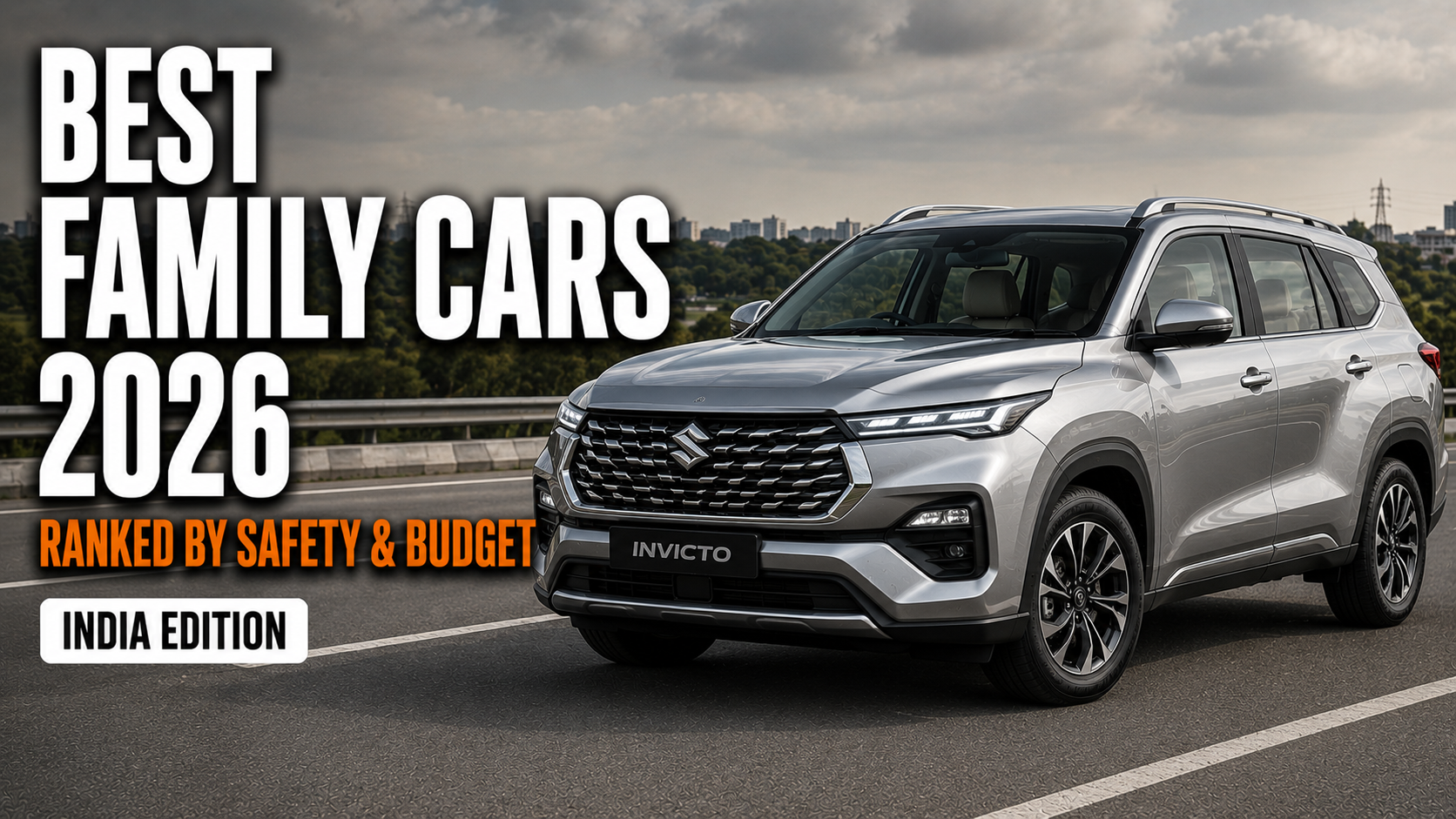

Picking the right family car in India is not just about which one looks good at the showroom. It is about whether it keeps your children safe on a state highway at midnight, whether the boot swallows a stroller plus four suitcases on a Diwali road trip, and whether you can get it serviced at a workshop in Gorakhpur without waiting three weeks for a spare part.
We have evaluated ten of the most relevant family cars on sale in India right now — using Bharat NCAP crash scores, real-world mileage data, boot volume, ISOFIX child seat support, and 5-year Total Cost of Ownership figures. Here is the straight answer before we go deeper.
Best Family Cars in India 2026
| Car | NCAP Rating | Seating | Starting Price (Ex-showroom) | Real-World Mileage | Boot (Litres) | Best For |
|---|---|---|---|---|---|---|
| Tata Punch | ⭐⭐⭐⭐⭐ (GNCAP) | 5 | ₹6.13 Lakh | 16–18 km/l | 366 | Budget, small families |
| Maruti Ertiga | ⭐⭐⭐ (GNCAP) | 7 | ₹8.94 Lakh | 19–21 km/l (CNG) | 209 (3rd row up) | Large families, CNG cities |
| Tata Nexon | ⭐⭐⭐⭐⭐ (BNCAP) | 5 | ₹8.10 Lakh | 14–16 km/l | 350 | Safety-first, 5-seater |
| Hyundai Creta | ⭐⭐⭐⭐ (GNCAP) | 5 | ₹10.99 Lakh | 13–16 km/l | 433 | Premium 5-seater |
| Kia Seltos | ⭐⭐⭐⭐⭐ (BNCAP) | 5 | ₹10.99 Lakh | 14–16 km/l | 433 | Tech-forward families |
| Maruti Grand Vitara (Hybrid) | ⭐⭐⭐⭐ (GNCAP) | 5 | ₹13.99 Lakh | 23–27 km/l | 373 | Highway, low running cost |
| Kia Carens | ⭐⭐⭐⭐⭐ (GNCAP) | 6/7 | ₹10.65 Lakh | 14–17 km/l | 216 (7-seat) | 3-generation families |
| Tata Safari | ⭐⭐⭐⭐⭐ (BNCAP) | 6/7 | ₹16.19 Lakh | 12–15 km/l | 447 (5-seat) | Prestige + safety, big families |
| Mahindra XUV 7XO (XUV700) | ⭐⭐⭐⭐⭐ (GNCAP) | 5/7 | ₹14.02 Lakh | 14–16 km/l | 480 (5-seat) | Tech + off-road mix |
| Toyota Innova Hycross | ⭐⭐⭐⭐⭐ (BNCAP) | 7/8 | ₹21.35 Lakh | 21–23 km/l (Hybrid) | 214 (all rows up) | Long trips, joint families |
How to Choose: Match the Car to Your Family Type
Before you test-drive anything, know which category your family falls into. This is the step most buyers skip — and it is why they end up with a seven-seater that cannot fit in their apartment’s parking spot, or a hatchback that buckles under highway load.
Nuclear family (2 adults + 1–2 kids): You need a safe, practical 5-seater. Prioritise Bharat NCAP score and ISOFIX child seat anchors. Boot space of 350+ litres handles school bags, a stroller, and a grocery run simultaneously. Best picks: Tata Nexon, Tata Punch (budget), Hyundai Creta (feature-rich).
Joint family or 3-generation travel (6–8 people regular): The third row cannot be an afterthought. On Indian roads — where a Pune–Mumbai trip can stretch to four hours — third-row passengers need a proper headrest, their own AC vents, and a flat floor so there is no awkward tunnel hump. The Kia Carens and Innova Hycross deliver this. The Ertiga and Safari are acceptable; the Hector Plus and MG Gloster are for larger budgets.
Frequent long-road-trip family: Running cost per kilometre matters more than sticker price. The Maruti Grand Vitara Strong Hybrid delivers 23–27 km/l real-world, which at ₹106/l petrol works out to roughly ₹4.0–₹4.6/km. Compare that to a diesel XUV700 at ₹9–10/l diesel and ~15 km/l highway — that is ₹6.0–₹6.6/km. Over 1.5 lakh km of ownership, the hybrid saves you roughly ₹30,000–₹40,000 in fuel alone. The Innova Hycross hybrid is even more efficient but costs ₹8 lakh more upfront; the break-even hits at approximately 1.2 lakh km of combined use.
Tier-2 or tier-3 city buyer: Service network density is your hidden deal-breaker. Maruti Suzuki has 4,000+ service points across India — no other brand comes close. Tata Motors and Hyundai each have 1,300–1,500+ workshops. Kia and Mahindra trail in small towns. If you live in a city with under 5 lakh population, owning a Kia Carens or Seltos means a 60–120 km trip for most major services.
The 10 Best Family Cars in India for 2026
1. Tata Punch — Best Budget Family Car Under ₹10 Lakh
The Punch is the safety overachiever in the Indian market. It earned a 5-star Global NCAP rating with 16.45/17 in adult occupant protection — the highest score in its price band at launch. In 2026, the facelifted version adds 6 airbags as standard from the mid-trim upward, ISOFIX anchors, and ESP. For a car starting at ₹6.13 lakh ex-showroom, nothing else in India gives you this crash protection.
Who it is for: Young families in cities with one child, buyers upgrading from a WagonR or Alto, anyone who wants 5-star safety without crossing ₹9 lakh on-road.
Real-world mileage: 16–18 km/l petrol; the CNG variant returns 26–28 km/kg.
What competitors won’t tell you: The Punch’s 366-litre boot is class-leading for a mini-SUV, but fold the rear seat and the load floor is not flat — there is a step. A stroller fits, but you cannot roll it in smoothly. That is the one ergonomic gotcha Tata has not fixed yet.
Not for you if: You regularly seat five adults. Rear knee room is adequate for two children and a medium-build adult; three adults in the back is a squeeze on drives longer than an hour.
2. Maruti Suzuki Ertiga — Best 7-Seater Under ₹15 Lakh
The Ertiga is not glamorous, and that is exactly why it works. It has been the bestselling MPV in India for nearly a decade because it solves the core equation: genuine seven-seat space, fuel efficiency that a middle-class family can live with, and Maruti’s unmatched service network.
Who it is for: Families of five or more, CNG city users, buyers in tier-2 and tier-3 cities who need peace of mind that a repair is never more than 10 km away.
TCO advantage of CNG: The Ertiga CNG costs roughly ₹1.25–1.50/km in fuel at current CNG prices in metro cities . A petrol-only 7-seater competitor at similar prices (say, the Renault Triber) runs at ₹5–6/km petrol. Over five years and 1 lakh km, that is a saving of ₹3.5–4.5 lakh in fuel cost alone.
The one honest limitation: The Ertiga’s 3-star GNCAP rating is a real concern for highway driving. Maruti has since reinforced the body, but if safety is your absolute priority and you need seven seats, the Kia Carens (5-star GNCAP) or Tata Safari (5-star BNCAP) are the safer step-ups.
Not for you if: You regularly do four-hour or longer highway stretches with all seven seats occupied. On such routes, the third row is usable but not comfortable for adults — knees hit the second-row seats if those are pushed all the way back.
3. Tata Nexon — Safest Compact SUV, Best All-Rounder
The Nexon was the first mass-market Indian car to score a 5-star GNCAP rating. In 2026, it has also achieved a 5-star Bharat NCAP rating, cementing its status as the safety benchmark in the compact SUV segment. The structure holds up across petrol, diesel, and EV variants, which means you get crash protection regardless of which powertrain you choose.
Who it is for: Families prioritising safety above all else in a compact SUV, buyers who want one car for both city commuting and occasional highway trips, those considering an EV for the future (the Nexon EV shares the same platform).
Actual specs that matter for families: 350-litre boot (fits one large + one cabin bag), ISOFIX anchors on the rear outboard seats, 6 airbags from the mid variant, rear AC vents standard, 209 mm ground clearance for waterlogged urban roads.
What most reviews miss: The 2026 Nexon facelift moved the rear AC vent controls to the B-pillar — passengers now control their own temperature without reaching to the front. That is a small but meaningful quality-of-life upgrade for rear-seat families.
Not for you if: You have three children or elderly passengers who need easy cabin entry. The roofline is low enough that taller adults regularly graze their heads getting into the back seat.
4. Hyundai Creta — Best-Selling Premium 5-Seater
The Creta is India’s bestselling SUV for a reason. It offers more interior width than the Nexon, a panoramic sunroof that families actually use, ventilated front seats, and a 433-litre boot — 83 litres more than the Nexon. The 2025 model also added a surround-view monitor and ADAS features including lane-keep assist to mid-variants.
Who it is for: Families wanting a premium daily driver with maximum features, dual-income households, buyers who prioritise ride quality on city roads over outright off-road capability.
Safety note: The Creta holds a 4-star GNCAP rating, one star below the Nexon and Seltos. In the 2024 GNCAP batch test, the adult occupant protection scored 28.47/34 — decent, but below the Nexon’s 5-star threshold. If crash safety is the deciding factor, the Seltos or Nexon is the pick. If the full feature package matters more, the Creta leads.
Not for you if: You live in a tier-2 or tier-3 city and are worried about resale. The Nexon, Brezza, and Seltos hold marginally better value in smaller markets where Maruti and Tata brand loyalty is stronger.
5. Kia Seltos — Best-in-Segment Safety, Premium Interior
The new Kia Seltos achieved a 5-star Bharat NCAP rating, making it one of only a handful of compact SUVs to match the Nexon’s crash credentials. On top of that, it offers one of the most premium interiors in the under-₹20 lakh segment — dual-curved screens, Bose audio, and a digital key feature that lets you share access via a smartphone app.
Who it is for: Tech-forward families who want 5-star safety plus premium features, dual-income urban couples adding a second car, buyers who compare closely with the Creta but want better crash protection.
Real-world ride quality note: The Seltos rides slightly firmer than the Creta on broken city roads. With toddlers in rear-facing seats, the extra jolt is noticeable. Kia has tuned it for dynamic handling, not maximum cushioning — keep this in mind if your daily route has severe speed bumps or unpaved stretches.
Not for you if: You are in a city where Kia service is sparse. Kia’s workshop network is approximately 700+ across India, which is solid in metros but thin in cities under 3 lakh population.
6. Maruti Grand Vitara (Strong Hybrid) — Best for Fuel-Conscious Families
The Grand Vitara’s Strong Hybrid variant is a different kind of family car. It does not chase the most airbags or the biggest touchscreen. It does something more useful for Indian families: it cuts your monthly fuel bill by 40–50% compared with a standard petrol SUV of similar size.
The numbers: ARAI-certified 27.97 km/l; real-world tested at 23–25 km/l in mixed driving. At ₹106/l petrol, that is ₹4.2/km. A Creta diesel at 15 km/l costs ₹6.5/km (diesel at ₹97/l). Over 1.5 lakh km: ₹33,000 saved in fuel.
Who it is for: Families covering 1,500–2,500 km per month in mixed city and highway driving, buyers in cities with poor EV charging infrastructure who want lower running costs without EV range anxiety.
Who it is NOT for: Pure highway users. The hybrid battery advantage drops at continuous speeds above 80 km/h, where the system runs mostly on the petrol engine. In that scenario, you are paying ₹2–3 lakh extra upfront for minimal fuel savings versus a standard petrol variant.
7. Kia Carens — Best 6/7-Seater for the Price
The Carens sits in a genuinely useful gap that few cars in India address: it is an MPV with a 5-star GNCAP safety rating, a price starting under ₹11 lakh, and a third row that adults can actually sit in for an hour without suffering. The one-touch tumble second-row seats with walk-in access are a real-world family feature — parents loading toddlers into the third row no longer need to be gymnasts.
Who it is for: Three-generation families in the ₹12–18 lakh budget, buyers choosing between the Ertiga and Safari who want better crash protection than the Ertiga but cannot afford the Safari.
Actual third-row livability: The Carens third-row headroom is 888 mm. Adults under 5’8″ can sit there for 60–90 minutes without significant discomfort. Beyond that, legroom becomes the constraint.
Not for you if: You want the third row for adults on a 4+ hour highway run. For that use case, the Innova Hycross is the correct answer, at a significantly higher price.
8. Tata Safari — Safest 7-Seater in Its Price Range
The Safari was the first vehicle in India to achieve a perfect 5-star rating under Bharat NCAP for both adult and child occupant protection — the same protocol that now tests all new cars sold in India. Built on the OMEGARC platform (derived from Land Rover’s D8 architecture), the Safari’s shell offers survival space that larger SUVs selling at double the price would struggle to match.
Who it is for: Families where safety is non-negotiable and the budget extends to ₹17–22 lakh, buyers who need seven real seats plus strong road presence, those doing regular state highway drives in India where road quality and accident risk are unpredictable.
Boot space context: With all three rows up, boot space is 73 litres — enough for soft bags only. Fold the third row and it opens to 447 litres. Real-world family use means the Safari is a practical five-seater with a pop-up third row, not a daily seven-seater.
Not for you if: Fuel cost is a concern. The Safari’s diesel returns 12–14 km/l city and 15–17 km/l highway — reasonable for the size, but noticeably higher running costs than the Grand Vitara Hybrid or Innova Hycross.
9. Mahindra XUV 7XO (XUV700) — Best Tech + Safety Combination
The XUV700, now sold as the XUV 7XO in its 2026 avatar, was the car that brought Level 2 ADAS to the Indian mass market. Features like Autonomous Emergency Braking, Lane Keep Assist, and Blind-Spot Warning — which still cost extra on most European cars — are standard on the AX7 variant. It also has a dual-screen dashboard and one of the best in-cabin sound systems under ₹25 lakh in India.
Who it is for: Families who drive fast on highways and want technology actively preventing accidents, tech enthusiasts who use their car as a second office, buyers wanting maximum features in the ₹14–24 lakh segment.
Real-world ADAS note: The AEB system works best at speeds between 30–80 km/h on open roads. In heavy city traffic with stop-and-go conditions, it can trigger false alerts. Disable ADAS on Pune or Bengaluru ring road peak-hour traffic — re-enable on the highway.
Not for you if: You have young children and switch off ADAS. Without active safety systems, the XUV700’s passive crash score (5-star GNCAP) is excellent, but the car’s weight and size mean parking in tight city spaces requires practice and ideally the 360-degree camera.
10. Toyota Innova Hycross — Best Family Car for Long Road Trips, No Compromise
The Innova Hycross achieved 5-star Bharat NCAP ratings for both adult (30.47/32) and child (45/49) occupant protection. The hybrid powertrain returns 21–23 km/l in real-world mixed use, which at ₹106/l petrol is ₹4.6–5.0/km — a number that a petrol 7-seater MPV simply cannot touch. The ottoman second-row seats recline to almost flat, which is meaningful for families doing Delhi–Jaipur or Mumbai–Goa drives with elderly or young children.
Who it is for: Joint families buying their “one serious car,” buyers upgrading from an older Innova Crysta, anyone who does 3–5 road trips per year and wants hotel-level rear-seat comfort.
The number competitors don’t show: Toyota Innova has held a resale value of 65–75% after three years in the used car market. For a car costing ₹21–26 lakh ex-showroom, that translates to a depreciation of ₹6–8 lakh over three years — lower than most premium SUVs in its price band.
Not for you if: Your budget is under ₹22 lakh on-road. The base Innova Hycross (GX variant) strips out most of the features that make it worth buying. Budget at minimum ₹25 lakh on-road for the ZX or ZX(O) variant to get the otto-man seats, panoramic roof, and 360-degree camera.
Fuel Type: Which Should Your Family Choose?
This is the most consistently underanswered question in family car buying guides. Here is the honest breakdown:
| Fuel Type | Best For | Avoid If |
|---|---|---|
| Petrol | City driving under 1,200 km/month, newer car, tier-3 city with no CNG pump | High monthly mileage, diesel discipline user |
| Diesel | Monthly mileage above 2,000 km, long highway stretches, resale in 4+ years | Short city hops, parking in enclosed basements (NMC rules in some cities) |
| CNG (factory-fitted) | CNG pump within 5 km of daily route, monthly mileage 1,500–3,000 km, Ertiga/Brezza user | State highways where CNG pumps are sparse, large boot requirement (CNG tank shrinks it) |
| Strong Hybrid | Mixed 1,500–2,500 km/month, petrol preferred, want low fuel cost without EV anxiety | Mostly highway, price-sensitive buyer, rural areas without authorised Toyota/Maruti service |
| Electric | Own charging at home/office, city commuter under 80 km/day, second family car | Single-car family in tier-2/3 city, frequent 300+ km highway trips |
Total Cost of Ownership: 5-Year Snapshot
Most families compare ex-showroom prices and stop there. Here is what ownership actually costs across five years at 1,200 km/month (14,400 km/year, 72,000 km total):
| Car | On-Road Price (Approx) | 5-Year Fuel Cost | 5-Year Service Cost (Est.) | Resale Value (5 Yr) | Net Ownership Cost |
|---|---|---|---|---|---|
| Tata Punch (Petrol) | ₹8.5L | ₹4.5L | ₹90,000 | ₹4.5L | ~₹9.5L |
| Ertiga CNG | ₹12.5L | ₹1.35L | ₹1.1L | ₹6.5L | ~₹8.5L |
| Tata Nexon (Petrol) | ₹12.0L | ₹5.1L | ₹1.0L | ₹6.0L | ~₹12.1L |
| Grand Vitara Hybrid | ₹18.5L | ₹3.0L | ₹1.2L | ₹10.5L | ~₹12.2L |
| Innova Hycross Hybrid | ₹29.0L | ₹3.3L | ₹1.5L | ₹19.5L | ~₹14.3L |
Fuel cost calculated at ₹106/l petrol, ₹86/l CNG equivalent. Real-world mileage used, not ARAI figures.
The insight most guides skip: The Ertiga CNG has the lowest net ownership cost in this table — not because it is cheap to buy, but because CNG running costs are one-fourth of petrol. If your city has reliable CNG infrastructure, this is the financially smartest family car in India.
What NCAP Ratings Actually Mean for Indian Families
India now has two active crash test programmes:
Bharat NCAP (BNCAP): Launched in August 2023 by the Ministry of Road Transport and Highways. Tests conducted at 64 km/h frontal offset and 50 km/h side impact. A 5-star BNCAP rating requires at least 27/32 in Adult Occupant Protection and 41/49 in Child Occupant Protection. As of May 2026, cars confirmed with 5-star BNCAP include: Tata Nexon, Tata Punch EV, Tata Safari, Tata Harrier, Tata Altroz, Tata Sierra, Toyota Innova Hycross, Kia Seltos, Renault Duster, Mahindra XUV 7XO (XUV700).
Global NCAP: The older international programme that tested Indian-market cars from 2014 to 2023. BNCAP is now the primary reference, but GNCAP ratings for older models like the Nexon and Carens remain valid and comparable.
What a 0-star car means: The Maruti Alto K10, tested by GNCAP, received 0 stars for adult occupant protection. This does not mean it explodes in a crash — it means the structure collapsed in a way that would cause serious head or chest injury at test speeds. If you are buying a ₹4–5 lakh car for your family, the Tata Punch at ₹6.13 lakh is not “too expensive” — the safety gap justifies every rupee.
Safety Features Checklist Before You Sign
Non-negotiable for any family car in India, regardless of budget:
- 6 airbags (not 2): Side and curtain airbags protect in the lateral impacts most common on Indian two-lane highways
- ESP/ESC: Electronic Stability Control prevents skidding; mandatory on all new cars sold after April 2023 by MoRTH regulation, but check older stock
- ISOFIX child seat anchors: If you have a child under 4 years, this is essential; always verify it is present in the specific variant you are buying — not just in top-trim
- Rear AC vents: Non-negotiable for any car bought in North or Central India where summer cabin temperatures regularly touch 50°C
- Rear parking sensors + camera: Not just convenience — backing into a narrow lane in a market or school pickup zone is the most common urban accident scenario
When to Walk Away
Walk away from any car if:
- It has a 0 or 1-star NCAP rating and will be your family’s only car. No discount justifies this if children are regularly in the vehicle.
- The service centre is more than 30 km from your home. An average warranty claim or periodic service requires 4–6 visits in five years. Distance compounds.
- The boot space is under 300 litres and you have a child under two with a stroller. You will hate the car within six months.
- You are buying a top-end variant purely for features you will not use in daily driving. The mid-trim of a 5-star NCAP car beats the top trim of a 3-star one.
Frequently Asked Questions
Which is the best 7-seater family car in India under ₹15 lakh?
The Kia Carens is the strongest choice — it has a 5-star GNCAP rating, a starting price of ₹10.65 lakh, and genuine six or seven-seat practicality with a one-touch tumble second row. For pure value, the Maruti Ertiga with CNG lowers running costs dramatically but comes with a 3-star GNCAP safety rating, which is a meaningful step down. If the budget stretches to ₹16–17 lakh, the Tata Safari adds 5-star BNCAP certification and significantly more road presence.
Which is the safest family car in India in 2026?
By Bharat NCAP scores, the Tata Safari and Tata Harrier achieved the highest combined ratings in their respective segments in the inaugural round of BNCAP testing. The Safari scored perfectly in child occupant protection and achieved 5-star overall — making it the safest mass-market seven-seater tested in India as of early 2026. For compact SUVs, the Tata Nexon and Kia Seltos are equally rated at 5-star BNCAP. For hatchbacks, the Tata Altroz holds the top spot.
Is a diesel or petrol car better for Indian families in 2026?
It depends on monthly mileage. Diesel makes financial sense if you are driving more than 2,000 km per month on a mix of city and highway. Below that, modern petrol engines — especially in hybrid form (Grand Vitara, Innova Hycross) — match or beat diesel on running cost with lower maintenance. CNG remains the cheapest fuel option if you are in a metro or city with reliable CNG supply. New diesel cars also face restrictions in some NGT zones, so check if your city has odd-even or diesel ban orders in effect.
What is the best family car for long road trips in India?
The Toyota Innova Hycross is the benchmark for long-haul family travel in India. The ottoman reclining second row, 21–23 km/l hybrid efficiency, 5-star BNCAP safety, and Toyota’s reliability record across Indian road conditions make it the correct answer for families doing 4+ hour drives regularly. At a lower budget, the Kia Carens and Tata Safari are strong alternatives.
Which family car has the lowest maintenance cost in India?
Maruti Suzuki consistently leads on per-km service cost due to its parts availability and workshop density. The Ertiga CNG has the lowest combined fuel + maintenance cost in the 7-seater segment. For 5-seaters, the Swift and Baleno are cheapest to maintain but lack adequate crash safety for primary family use. Among safer 5-seaters, the Tata Nexon has lower service costs than Hyundai or Kia equivalents due to Tata’s growing parts network.

《Best Cars for Family in India 2026: Ranked by Safety, Space & Budget》有1条评论