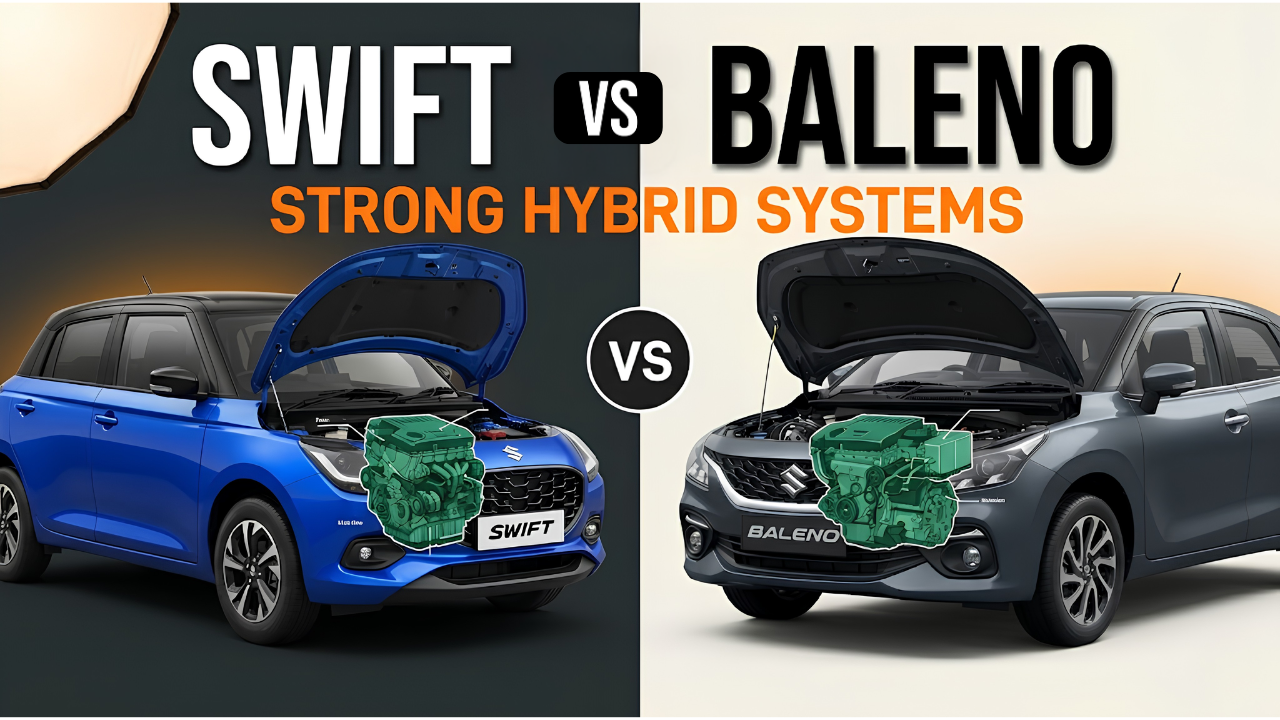

Big changes. The Indian hatchback segment is about to undergo its most significant mechanical shift since the transition to BS6 norms. Maruti Suzuki is preparing to launch the Swift Strong Hybrid and Baleno Strong Hybrid, featuring a new, in-house developed “Series Hybrid” powertrain that could change your monthly fuel bill forever. This technology promises to push fuel efficiency toward the 40 kmpl mark, effectively making petrol hatchbacks more economical to run than their CNG or diesel predecessors.
Unlike the mild-hybrid (SHVS) systems currently found in these cars, which only provide a small electric boost during acceleration, the new Strong Hybrid system allows for significant periods of pure electric driving. It works. For city commuters, this means the engine will often remain off while the car is propelled by a high-torque electric motor, drastically reducing fuel consumption in stop-and-go traffic.
Current Mild Hybrid vs. Upcoming Strong Hybrid
| Feature | Mild Hybrid (12V SHVS) | Strong Hybrid (Series HEV) |
|---|---|---|
| Primary Driver | Petrol Engine | Electric Motor (via Battery) |
| Engine Role | Propels wheels + ISG assist | Acts as a generator for battery |
| Pure EV Mode | No | Yes (Low speeds / City traffic) |
| Expected Mileage | 22 – 25 kmpl | 35 – 40 kmpl |
| Estimated Premium | – | ₹1.5 Lakh – ₹2.5 Lakh |
| Best For | Budget-conscious buyers | High-mileage city commuters |
The Suzuki Series Hybrid: How It Differs from Toyota’s System
The catch? Most Indian car buyers are familiar with the “Strong Hybrid” term through the Maruti Grand Vitara or Toyota Hyryder. However, the technology slated for the Swift and Baleno is fundamentally different. While the Grand Vitara uses a Series-Parallel system (where both the engine and motor can drive the wheels), the new Suzuki Strong Hybrid is a dedicated Series Hybrid system, codenamed “HEV.”
Think of it as a range-extender. In this setup, the 1.2-litre petrol engine isn’t mechanically connected to the wheels. Instead, it functions solely as a generator to charge a 1.5–2 kWh lithium-ion battery pack. This battery then powers a high-output electric traction motor that actually turns the wheels. This is similar to Nissan’s e-Power technology and is optimized for the smaller engine bays of hatchbacks like the Swift, where fitting a complex Toyota-style power split device would be both a packaging nightmare and an expensive engineering hurdle.
The advantage of a Series Hybrid is simplicity and efficiency in the city. Since the engine doesn’t have to deal with varying loads of driving the wheels, it can run at its most efficient RPM (thermal efficiency sweet spot) to generate electricity. This results in the staggering 35 kmpl+ mileage figures being reported.
Under the Hood: The Z12E 3-Cylinder Engine
It’s efficient. The heart of the Swift Strong Hybrid is the new Z12E engine. Moving away from the legendary K-Series 4-cylinder blocks, Suzuki has developed this 1.2-litre, 3-cylinder unit with a focus on low-end torque and thermal efficiency.
- Refinement vs. Efficiency: While some enthusiasts on r/CarsIndia have expressed concerns about the “thrum” of a 3-cylinder engine compared to a 4-cylinder, Suzuki has utilized advanced counter-balancers and hydraulic engine mounts to minimize vibrations. Truthfully, this varies by driver preference, but for most city users, the electric motor’s silence will more than compensate for the 3-cylinder’s character.
- Thermal Efficiency: The Z12E is designed to hit nearly 40% thermal efficiency, a high benchmark for mass-market engines.
- The Transmission: You won’t find a traditional AMT or Torque Converter here. The system will likely use an e-CVT or a dedicated hybrid transmission that provides a seamless, gearless acceleration experience similar to an EV.
The Baleno Strong Hybrid: A Premium City Commuter
Silent power. While the Swift targets the “fun-to-drive” demographic, the Baleno Strong Hybrid is positioned as the ultimate urban tool. Expected to launch in late 2026, the Baleno HEV will likely be the first hatchback in India to cross the ₹12 Lakh mark for a non-performance variant, but it justifies this with features and frugality.
But here’s the reality. Key expectations for the Baleno Strong Hybrid include:
- Silent Starts: The car will always start in EV mode, providing a premium, silent experience in residential areas.
- Regenerative Braking: In heavy city traffic, the electric motor acts as a generator during braking, “recapturing” energy that would otherwise be lost as heat.
- Feature Additions: Rumors suggest the Strong Hybrid Alpha variant may finally introduce a factory-fitted sunroof and ventilated seats to further differentiate it from the standard petrol model.
Cost-Benefit Analysis: Does the ₹2 Lakh Premium Make Sense?
Real talk. The biggest hurdle for strong hybrid technology in the hatchback segment is the upfront cost. At an estimated premium of ₹2 Lakh over the standard petrol model, many buyers wonder if they will ever “break even.”
The Math (Estimated):
- Petrol Swift: 24 kmpl | Fuel cost for 10,000 km (at ₹100/L) = ₹41,666
- Strong Hybrid Swift: 38 kmpl | Fuel cost for 10,000 km = ₹26,315
- Annual Savings: ~₹15,351
- Break-even Period: ~13 years (at 10,000 km/year).
Wait, there’s more. The reality is that for a user driving 2,000 km per month (24,000 km/year), the savings jump to nearly ₹37,000 per year, bringing the break-even period down to roughly 5.4 years. This makes the Strong Hybrid an excellent choice for those with long daily commutes or those who primarily drive in heavy city traffic where petrol mileage usually drops to 12-14 kmpl, but hybrids stay at 30+ kmpl.
When to Skip the Strong Hybrid
The catch? Despite the “40 kmpl” headlines, the Swift or Baleno Strong Hybrid isn’t the right choice for everyone. You should stick to the standard petrol or CNG variants if:
- You are a Highway-Only Driver: Series hybrids are least efficient at sustained high speeds (above 100 km/h) because the engine has to work hard to generate electricity for a motor that is fighting wind resistance. On highways, a standard petrol car might actually be more efficient.
- Low Annual Mileage: If you drive less than 800 km a month, the interest on the ₹2 Lakh premium will likely be higher than your fuel savings.
- Boot Space Priority: Strong hybrids require a traction battery, which is typically placed under the boot floor or rear seat. Expect a 15-20% reduction in boot capacity compared to the standard model.
Conclusion
A new era. The introduction of Suzuki strong hybrid technology in the Swift and Baleno marks the end of the “Mild Hybrid” era as a headline feature. By bringing EV-like efficiency to the mass market without the “range anxiety” of a pure electric vehicle, Maruti Suzuki is positioning itself to dominate the next decade of Indian motoring.
If you spend three hours a day in Bangalore or Mumbai traffic, the Swift Strong Hybrid isn’t just a car; it’s a financial instrument that pays you back every time you hit the brake. Check the price, do the math, and decide if your commute justifies the upgrade.
FAQ
When is the Swift Strong Hybrid launching in India?
While the standard Swift is already on sale, the Strong Hybrid (HEV) version is expected to debut between late 2026 and early 2027, following the launch of the Fronx Facelift.
What is the expected mileage of the Baleno Strong Hybrid?
The Baleno Strong Hybrid is targeted to deliver between 35 kmpl and 40 kmpl under ARAI testing conditions, making it the most efficient car in its class.
Is Suzuki’s strong hybrid better than Toyota’s?
It depends. Suzuki’s Series Hybrid is simpler and potentially cheaper to manufacture for small cars. Toyota’s Series-Parallel system is more efficient at high speeds but more complex. For city use, Suzuki’s system should be equally effective.