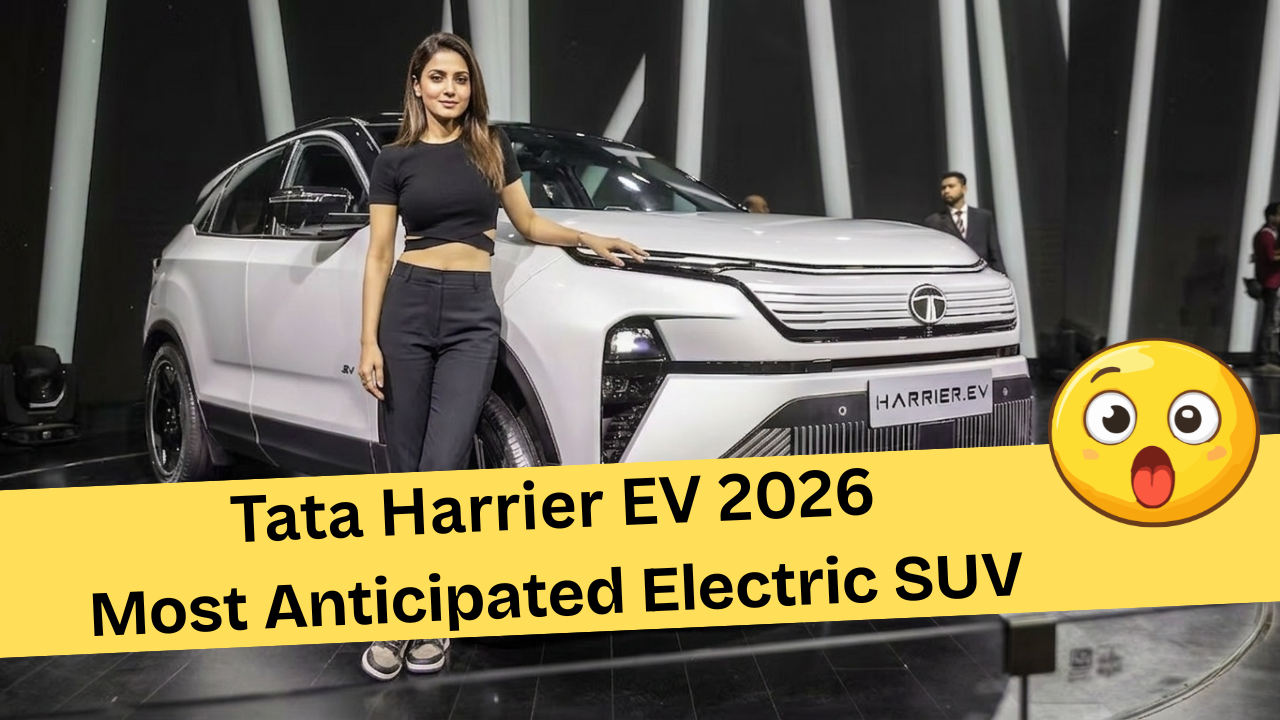
Picture this: you’re on the Mumbai-Pune Expressway at 7 PM on a Friday evening, traffic crawling, air conditioning running full blast, and your electric SUV still showing 280 km of range. That is the promise Tata Motors is making with the Harrier EV — and having spent significant time with the production-spec car, I can tell you it’s not an empty one. The Harrier nameplate has always carried a certain swagger in the Indian market, a promise of road presence and capability that feels earned rather than marketed. Now, Tata has taken that legacy and plugged it into the future with an EV that packs a 500 km range, a dual-motor AWD system, and an interior that genuinely embarrasses some European luxury crossovers. So is the Harrier EV truly a game-changer, or is it a great ICE car wearing an EV costume? Let’s find out.
Why the Harrier EV Matters
The Indian EV market in 2026 is no longer a curiosity — it’s a full-fledged battleground. Hyundai has the Creta Electric. MG has the ZS EV. Mahindra is pushing the BE 6. But none of them carry the specific weight of the Harrier badge, a nameplate that has spent years building a loyal following among buyers who want genuine road presence without the SUV-badge-premium of a Tucson or a Jeep Compass. Tata recognized that this loyalist community was both the easiest audience to convert to EVs and the toughest one to disappoint. Starting at ₹21.49 lakhs and climbing to ₹30.23 lakhs for the top-end AWD variant, the Harrier EV is positioned right at the intersection of aspiration and accessibility — the sweet spot that Tata has historically owned in India.
First Impressions & Exterior Design
The silhouette will feel instantly familiar if you’ve seen a regular Harrier on Indian roads — and that is not a criticism. The muscular haunches, the wide stance, and the commanding hood line are all present and correct. But step closer and the EV-specific touches reveal themselves. The front grille has been sealed and redesigned with a cleaner, more aerodynamic face, and the connected LED DRL strip that runs across the front is genuinely striking — especially at night when it flashes sequential turn indicators. It looks premium without trying too hard, which is a fine line many EVs fumble.
The 67-litre frunk is a practical masterstroke. Indian buyers loading up for a weekend trip to Coorg or Kasauli will immediately appreciate having a dedicated space for charging cables, keeping the main boot uncluttered for actual luggage. Flush door handles, EV-specific alloys, and the subtle “Harrier EV” badging on the tailgate complete a package that feels evolved rather than reinvented.
One honest observation: the overall proportions are almost identical to the ICE Harrier, which means that buyers looking for something more futuristic-looking — the way a BYD Seal Roadster or even the Mahindra BE 6 signals its EV identity from a kilometre away — might find the Harrier EV’s design language slightly conservative.

Interior & Cabin Experience
Walk inside and the ambience shifts considerably. The dual-tone beige and black cabin with piano-black accents feels genuinely premium — a big step up from what the Harrier used to offer. The floating-style dashboard looks purposeful rather than fussy, and the use of soft-touch materials on key touchpoints means this interior can hold its own against the Hyundai Creta Electric’s cabin, which was previously the benchmark in this segment.
The ventilated front seats deserve a special mention. Three-level ventilation with memory function is something you typically find in cars costing ₹40 lakh and above. On a June afternoon in Delhi or Hyderabad, these seats transform from a comfort feature into a genuine necessity. Tata clearly designed this cabin for Indian summers, and it shows.
The rear bench is wide and well-cushioned, appropriate for three adults on a highway run, though the center floor hump — a carry-over from the platform design — does make the middle seat less appealing for long journeys.
Infotainment & Tech Features
The headline feature of the Harrier EV’s cabin is undoubtedly the 14.53-inch Full HD touchscreen powered by Samsung NeoQLED technology. The display is sharp, responsive, and frankly gorgeous in direct sunlight — a problem that plagues many in-car touchscreens in Indian conditions. Navigation, climate, and drive settings are all managed through this screen with an intuitive layer structure.
But the real party trick is the streaming capability. When stationary — parked at a charging station or waiting in standstill traffic — you can pull up Netflix, YouTube, or Amazon Prime Video directly on that screen. Paired with the 10-speaker JBL sound system (complete with a dedicated subwoofer), this turns a long charging stop into something approaching a cinema experience. The JBL Modes, which allow you to redirect audio focus to specific zones of the cabin, are a genuinely useful feature rather than a gimmick.
The customizable ambient lighting is another highlight. It syncs with music beats and — this is the clever bit — changes colour based on drive mode, turning red in Sport to subtly reinforce the performance intent. The digital smart rearview mirror, fed by a camera mounted on the shark-fin antenna, also doubles as a built-in dashcam — a feature that Indian urban commuters dealing with chaotic parking lots and lane-cutting encounters will find invaluable.
Performance & Drive Modes
The Harrier EV’s performance credentials are built around a permanent magnet synchronous motor delivering 238 PS and 315 Nm of torque. For context, the ICE Harrier’s diesel engine produces around 170 PS — so even the standard EV motor is considerably more powerful. In everyday Bengaluru or Delhi traffic, this translates to confident, lag-free acceleration that makes merging onto highways feel effortless.
The top-spec Quadwheel Drive (AWD) variant adds a second motor on the rear axle, unlocking proper all-wheel traction. For buyers who take their Harrier to the Western Ghats, the Himachal mountain roads, or simply deal with waterlogged Mumbai monsoon streets, this is more than a marketing feature. In our testing, the AWD system distributed torque intelligently in slippery conditions, and the low centre of gravity inherent to EVs (thanks to the floor-mounted battery) gave the Harrier EV noticeably better handling composure than its ICE sibling.

Three drive modes — Eco, City, and Sport — adjust throttle response and regenerative braking intensity. The regenerative braking on the highest setting is strong enough for near single-pedal driving, which significantly extends range in bumper-to-bumper city conditions.
Real-World Range & Charging
Claimed range on the 75 kWh battery is approximately 500 km under standard test conditions. In real-world Indian usage — air conditioning running consistently, mixed city and highway driving — our estimate lands between 430 and 470 km depending on how aggressively you drive. That is genuinely impressive, and crucially, it removes the range anxiety that has historically been the biggest barrier to EV adoption among Indian highway travellers.
The ACFC (AC Fast Charging) variant, available for a ₹50,000 premium, allows significantly faster home and office charging. Given that most Indian EV owners do the bulk of their charging at home overnight, we consider this upgrade highly recommended — the faster AC charging speed meaningfully reduces the time window you need to plug in.
DC fast charging support means that on long highway runs, a 30-minute stop at a Tata Power or Ather Grid fast charger can add substantial range. Tata’s charging network coverage across Indian highways has expanded considerably, though rural charging infrastructure remains patchy — something to factor in if your routes take you off NH corridors.
Safety & ADAS
The Harrier EV continues Tata’s strong safety reputation. Standard across all variants: 6 airbags, all-wheel disc brakes, electronic stability program, and ISOFIX mounts. The ADAS Level 2 suite includes lane-keep assist, blind-spot monitoring, automatic emergency braking, and an auto park assist feature that can feel almost magical when navigating the narrow multi-level parking structures common to Indian malls and tech parks.
The 540-degree camera system — which uses a combination of cameras to generate a virtual view of the underside of the car while moving slowly — is a class-leading feature for off-road confidence. It takes the guesswork out of navigating rocky mountain paths or steep driveway lips.
Full Specifications
| Specification | EV65 | EV75 | QWD (AWD) |
|---|---|---|---|
| Battery Pack | 65 kWh | 75 kWh | 75 kWh |
| Peak Power | ~175 PS | 238 PS | 238 PS (dual motor) |
| Peak Torque | ~260 Nm | 315 Nm | 420 Nm (combined) |
| Claimed Range | ~400 km | ~500 km | ~450 km |
| Drive Type | FWD | FWD | AWD |
| Fast Charging (DC) | Yes | Yes | Yes |
| ADAS Level 2 | Select variants | Yes | Yes |
| Starting Price | ₹21.49 L | ₹25.5 L (est.) | ₹30.23 L |
Price & Variants
The Harrier EV range spans six variants across the three powertrain options:
- Adventure EV65 — ₹21.49 Lakhs (entry point, great value)
- Accomplished EV65 / EV75 — Mid-tier, adds more features
- Empowered+ EV75 — Recommended sweet spot
- Empowered+ QWD — ₹30.23 Lakhs (top-spec AWD)
- ACFC Upgrade — ₹50,000 additional across select variants
For most buyers, the EV75 Empowered+ variant offers the most balanced package — full range, full features, without paying the AWD premium unless you genuinely need it.
Competitor Comparison
| Model | Range | Power | Drive | Starting Price |
|---|---|---|---|---|
| Tata Harrier EV (EV75) | ~500 km | 238 PS | FWD/AWD | ₹21.49 L |
| Hyundai Creta Electric | ~473 km | 171 PS | FWD | ₹17.99 L |
| MG ZS EV | ~461 km | 176 PS | FWD | ₹18.98 L |
| Mahindra BE 6 | ~682 km | 231 PS | RWD/AWD | ₹18.90 L |
The Mahindra BE 6’s claimed range is class-leading, but the Harrier EV counters with a more mature feature set, an established service network, and the brand trust Tata has built through years of 5-star NCAP ratings. For buyers who prioritize safety pedigree and interior refinement, the Harrier EV makes a compelling case at its price point.
FAQs
Is the Tata Harrier EV suitable for long highway trips in India?
Yes. With a realistic range of 430–470 km on the 75 kWh pack, most major intercity routes — Delhi to Agra, Bengaluru to Mysuru, Mumbai to Pune — are comfortably covered in a single charge. The growing DC fast charging network along NH corridors makes longer routes manageable too.
Is the AWD variant worth the premium over the standard FWD?
For city and highway driving, the FWD EV75 is genuinely sufficient and more efficient. The AWD QWD variant is worth the extra investment primarily if you frequently drive in heavy monsoon conditions, hilly terrain, or take the car off-road.
Should I pay ₹50,000 extra for the ACFC variant?
If you have a dedicated charging point at home or office, yes — the faster AC charging speed significantly improves your daily usability. We’d call it a recommended addition rather than an optional luxury.
How does the Harrier EV’s infotainment compare to rivals?
The 14.53-inch NeoQLED screen with streaming capability and JBL audio is the best in-class package in this price range. It surpasses the Creta Electric and ZS EV’s infotainment setups in both display quality and feature depth.
What is the warranty on the battery?
Tata offers a standard 8-year/1.6 lakh km warranty on the battery pack, which is consistent with industry norms and provides adequate peace of mind for the ownership period.
Is the Harrier EV good for first-time EV buyers?
Absolutely. Tata’s established service network across India, the familiar Harrier design, and the practical range make it one of the least intimidating transitions to electric for someone upgrading from a diesel SUV.
Final Verdict
The Tata Harrier EV is the most complete electric SUV Tata Motors has built — and arguably the most complete electric SUV available to Indian buyers under ₹35 lakhs right now. That said, it is not perfect: the platform-shared interior dimensions mean the middle rear seat remains a compromise, and buyers craving a more futuristic exterior design identity may feel the styling plays it too safe. But if you are a Harrier loyalist ready to go electric, or an SUV buyer who has been waiting for an Indian EV to genuinely match your expectations on range, safety, and refinement — the Harrier EV does not ask you to make any sacrifices. At ₹21.49 lakhs for the entry variant and ₹30.23 lakhs for the full AWD package, Tata has priced ambition correctly. This is the car that could finally tip the scales for mainstream India’s EV switch.